At some point, almost everyone has searched for a person online—an old friend, a new neighbor, a business contact, or even their own name out of curiosity. People search platforms promise fast answers: addresses, phone numbers, relatives, and sometimes even background details, all in seconds. On the surface, tools like FamilyTreeNow, TruePeopleSearch, and Whitepages feel powerful, almost like a shortcut into someone’s life history.
But there’s a gap between what these sites promise and what they actually deliver.
The truth is more nuanced. These platforms don’t “know” people—they compile fragments of data from scattered sources and attempt to stitch them together into a profile. Sometimes that profile is impressively accurate. Other times, it’s outdated, incomplete, or simply wrong.
This raises a critical question: How accurate are people search sites in the United States?
The answer isn’t binary. Accuracy depends on where the data comes from, how often it’s updated, how common a name is, and how well the system merges different records. In this article, we’ll unpack how these tools work, where errors come from, and how you should interpret what you see.
What Are People Search Sites and How Do They Work?
People search websites are essentially data aggregation engines. They don’t create original data; they collect, combine, and display information pulled from various public and commercial sources.
Platforms like Spokeo and BeenVerified operate by scanning massive datasets and linking records based on identifiers such as name, phone number, email address, and physical address.
Where the Data Comes From
Most people search sites pull from a mix of:
- Public records
Property ownership, court filings, voter registrations, marriage licenses - Data brokers
Third-party companies that collect and sell consumer data - Telecom directories
Phone listings, both landline and sometimes mobile - Online footprints
Social media traces, forum posts, and other indexed content - Marketing databases
Purchased datasets used for targeted advertising
The key thing to understand is this: no single source is complete or perfectly current. These platforms rely on stitching together partial data points.
What “Accuracy” Really Means Here
When people ask if these sites are accurate, they usually mean, “Is this information correct?” But accuracy in this context has multiple layers.
1. Identity Match Accuracy
Does the data actually belong to the correct person?
2. Data Freshness
Is the information current, or is it outdated?
3. Completeness
Does the profile include all relevant information, or only fragments?
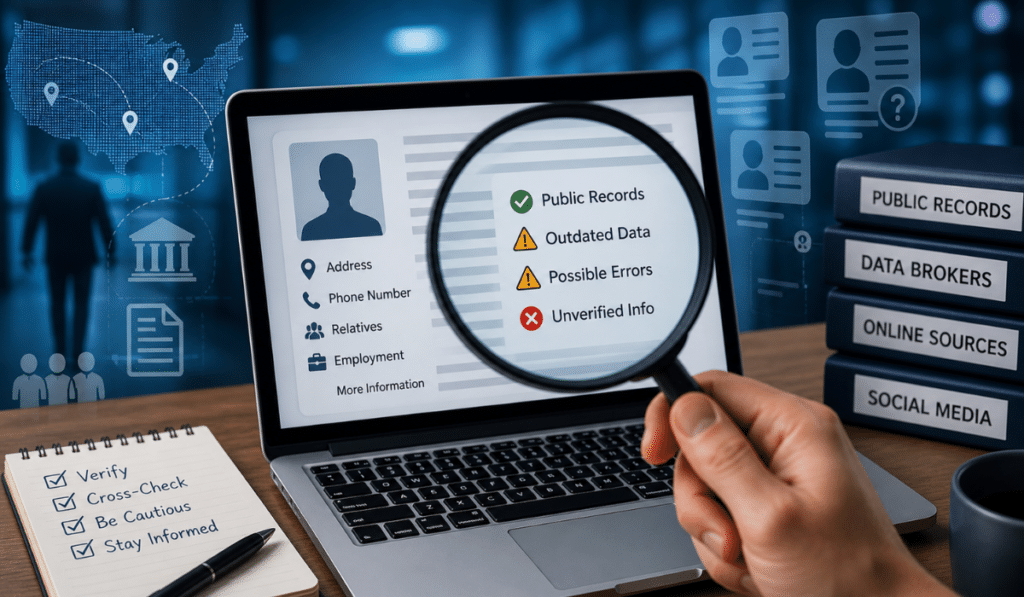
For example, a profile might correctly identify a person’s name and age but list an address from five years ago and a phone number that no longer works. Technically, parts of it are accurate—but the overall usefulness is limited.
Sources of Data and Their Reliability
To understand accuracy, you need to understand the reliability of each data source.
Government Records
Government records are often considered the most reliable. These include:
- Property ownership records
- Court documents
- Marriage and divorce filings
However, they are not updated in real time. A change in address or legal status can take months—or longer—to appear in public databases.
Commercial Data Brokers
Data brokers collect information from:
- Retail transactions
- Subscription services
- Online behavior
While these datasets are extensive, they are not always verified. Errors can enter the system easily and spread across multiple platforms.
Scraped and User-Generated Data
Some platforms rely on scraped or loosely verified data:
- Old online directories
- Archived listings
- Public forum mentions
This is the least reliable category and often contributes to incorrect associations.
Why People Search Sites Are Often Inaccurate
Even with massive datasets, inaccuracies are common. Here’s why.
Outdated Information
One of the biggest issues is data lag. If someone moves, changes jobs, or updates their phone number, those changes may not reflect immediately.
Common Names
Names like “John Smith” or “Michael Johnson” create a major challenge. Systems may:
- Merge multiple individuals into one profile
- Assign data from one person to another
Data Merging Errors
Aggregation algorithms try to connect records using matching signals. But when signals overlap—same name, similar age, nearby location—errors happen.
Incomplete Records
Not all data is public. Some records are:
- Restricted
- Delayed
- Never digitized
This leads to gaps that systems try to “fill,” sometimes incorrectly.
Address Recycling
Addresses change hands. A property that once belonged to one person may now belong to another, but older data may still associate the previous resident.
Real-World Examples of Data Errors
To make this concrete, here are typical scenarios users encounter:
Example 1: Wrong Phone Number
A profile lists a number that actually belongs to someone else who previously owned it.
Example 2: Incorrect Relatives
A system incorrectly links two people as relatives because they shared an address years ago.
Example 3: Outdated Address
A person who moved three years ago is still listed at their previous residence.
Example 4: Misattributed Records
A criminal record appears on a profile due to a name match, even though it belongs to a different individual.
These errors aren’t rare—they’re part of how aggregated systems behave at scale.
Free vs. Paid People Search Sites
There’s a common assumption: paid services must be more accurate. That’s only partially true.
Free Platforms
Sites like FamilyTreeNow and TruePeopleSearch provide:
- Basic profiles
- Limited filtering
- Public record snapshots
They often rely heavily on older datasets.
Paid Platforms
Services like BeenVerified offer:
- Expanded reports
- Additional data layers
- More structured presentation
However, paying doesn’t guarantee correctness. It usually means more data, not better data.
Legal Disclaimer: Why These Sites Avoid Liability
Most people search platforms include disclaimers referencing the Fair Credit Reporting Act (FCRA).
What This Means
- These sites are not consumer reporting agencies
- Their data cannot be used for:
- Employment decisions
- Tenant screening
- Credit evaluation
This legal framework protects them from liability if the data is wrong.
In simple terms: they provide information, not verified truth.
Privacy Concerns and Ethical Issues
Accuracy isn’t the only issue—privacy is equally important.
Data Exposure
Many users are surprised to find:
- Their address publicly listed
- Family members connected
- Old information resurfacing
Potential Misuse
Inaccurate data can lead to:
- Misidentification
- Harassment
- Stalking risks
Opt-Out Options
Platforms like FamilyTreeNow allow users to request removal of their data, but:
- The process takes time
- Data may reappear from other sources
How to Verify Information Found Online
If you use people search sites, treat them as a starting point—not a final answer.
Cross-Check Multiple Sources
Never rely on one platform. Compare results across multiple tools.
Use Official Records
Whenever possible, verify through:
- County property records
- Court databases
- Government portals
Validate Through Context
Check consistency:
- Does the timeline make sense?
- Are locations realistic?
Reverse Lookup
Use phone or email verification tools to confirm identity matches.
Pros and Cons of People Search Websites
Pros
- Fast access to information
- Useful for reconnecting with people
- Broad data coverage
Cons
- Frequent inaccuracies
- Outdated records
- Privacy concerns
- Misleading associations
Tips to Improve Your Search Accuracy
If you’re using these tools, you can improve results with better input.
- Include middle names or initials
- Add known locations
- Use age filters when available
- Try multiple platforms
- Avoid jumping to conclusions
Small refinements can significantly reduce mismatches.
Final Verdict: Can You Trust People Search Sites?
People search websites are neither completely unreliable nor fully dependable. They sit somewhere in the middle.
They are best viewed as informational tools, not authoritative sources. They can help you find leads, reconnect with people, or gather context—but they should never be the sole basis for decisions.
If you approach them with the right expectations—skeptical, curious, and willing to verify—you can extract real value. But if you treat them as definitive truth, you’re likely to run into problems.
In 2026, the technology behind these platforms continues to improve, but the core limitation remains the same: they are only as accurate as the data they collect—and that data is far from perfect.
FAQs
Are people search websites accurate in the USA?
They are partially accurate. Basic identity details may be correct, but addresses, phone numbers, and relationships are often outdated or mismatched.
Why is my information wrong online?
Because data comes from multiple sources that may not be updated or verified. Errors can spread across platforms.
Can I remove my data?
Yes, most sites offer opt-out options, though the process varies and may need to be repeated.
Are paid background checks more reliable?
They provide more data, but not necessarily more accurate data.
How often is public data updated?
It depends on the source. Some records update within weeks, others may take months or longer.

I am Sandy Saga, the writer and content researcher behind FamilyTreeNow.net. I create clear, easy-to-understand informational content related to family history, people search resources, genealogy topics, and public information awareness. My goal is to help readers understand how online search tools and family research resources work in a simple and responsible way.
The content on FamilyTreeNow.net is published strictly for informational and educational purposes only. I focus on providing accurate, transparent, and reader-friendly information to help users explore and learn. This website does not offer official records, legal advice, or professional services — it exists solely as an independent informational resource.