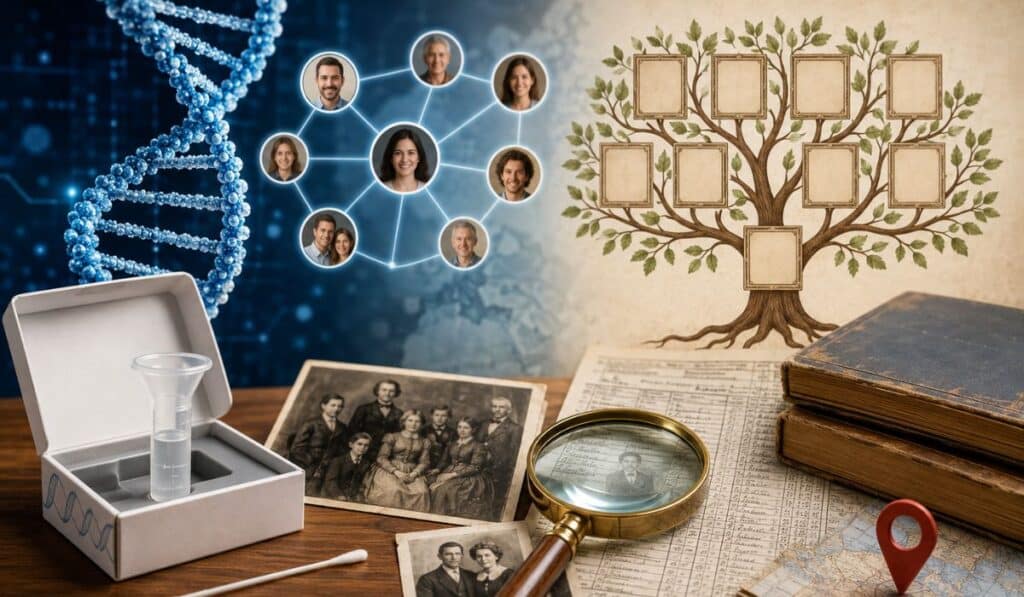
Finding family connections used to require handwritten records, courthouse visits, newspaper archives, and long hours spent building family trees. Today, DNA technology has changed that process dramatically. Many people now take genetic tests hoping to discover unknown relatives, reconnect with biological family members, verify family stories, or simply learn more about their heritage.
But one question appears repeatedly:
Can DNA Tests Help You Find Relatives?
The short answer is yes—but there are important details many people overlook.
During our research into genealogy resources and people search systems, we found that users frequently assume DNA testing instantly reveals complete family histories. In reality, DNA matching is only one piece of a much larger process.
One challenge people often face is understanding what a DNA result actually means. Receiving a list of names and match percentages does not automatically explain how someone fits into a family tree.
After analyzing public record databases and common genealogy workflows, a clear pattern emerges:
DNA testing works best when combined with traditional research methods such as:
• Census records
• Birth records
• Marriage records
• Public records databases
• Family trees
• Historical archives
• People search tools
In this guide, you’ll learn:
• How DNA tests actually identify relatives
• What types of relatives can be discovered
• The benefits and limitations of DNA matching
• Common mistakes users make
• Privacy concerns to understand
• Expert tips for getting better results
Can DNA Tests Really Find Family Members?
DNA testing compares specific segments of your genetic information with others stored in large databases.
When two people share matching DNA segments, testing systems estimate whether a biological relationship exists.
Possible matches may include:
• Parents
• Children
• Siblings
• Cousins
• Aunts and uncles
• Grandparents
• Distant relatives
The closer the biological relationship, the larger the amount of shared DNA typically becomes.
However, finding a DNA match and identifying the relationship are two different things.
Many users discover hundreds or even thousands of genetic matches after testing. The challenge is determining which matches matter.
How DNA Tests Work
Understanding the process helps eliminate unrealistic expectations.
Step 1: DNA Collection
Most DNA services collect a sample using:
• Saliva kits
• Cheek swabs
Laboratories then extract genetic material.
Step 2: Genetic Analysis
The laboratory analyzes specific markers across your genome.
Rather than examining every part of DNA, testing focuses on sections useful for identifying shared ancestry patterns.
Step 3: Database Comparison
Your results are compared against millions of other DNA profiles stored within the provider’s system.
The process looks for:
• Shared DNA segments
• Match percentages
• Estimated relationships
Step 4: Relationship Prediction
Algorithms estimate possible relationships based on shared genetic information.
Examples:
| Shared DNA Amount | Possible Relationship |
|---|---|
| Very High | Parent or sibling |
| Moderate | First cousin |
| Lower | Distant cousin |
| Very Low | Remote ancestry connection |
Based on common patterns observed across genealogy communities, closer relatives usually appear more clearly than distant family members.
Definition Box
What is a DNA relative match?
A DNA relative match is a person whose genetic information shares measurable similarities with yours, suggesting a biological relationship.
Key Features of DNA Relative Matching
Different DNA platforms offer different capabilities, but most include:
Relative Match Lists
Users receive lists of potential relatives ranked by estimated closeness.
Shared DNA Percentages
Systems estimate how much DNA is shared between two individuals.
Ethnicity Estimates
Many tests provide ancestry breakdowns based on regional genetic patterns.
Family Tree Integration
Some systems allow users to build and connect family trees.
Shared Match Features
Users may identify people connected to multiple family branches.
Messaging Systems
Many services include communication tools for contacting possible relatives.
Benefits of Using DNA Tests to Find Relatives
1. Reconnecting Biological Families
DNA testing may help:
• Adoptees
• Donor-conceived individuals
• Separated relatives
• Unknown family connections
2. Confirming Family Stories
Families often pass down stories across generations.
Examples include:
• immigration stories
• cultural origins
• unknown relatives
• surname histories
DNA evidence may support or challenge these narratives.
3. Expanding Family Trees
Researchers frequently use DNA matches to:
• verify ancestors
• identify missing branches
• discover additional relatives
4. Finding Previously Unknown Relatives
Users occasionally discover:
• half-siblings
• cousins
• grandparents
• extended family members
5. Supporting Genealogy Research
DNA alone rarely tells the whole story.
When combined with historical records, DNA can become a powerful research tool.
Limitations – What DNA Tests Cannot Always Tell You
DNA testing can be powerful, but expectations sometimes become unrealistic.
During our research into genealogy workflows and public record systems, users frequently encounter confusion after receiving results that appear incomplete or inconsistent with family expectations.
A DNA test identifies biological relationships through shared genetic material. It does not automatically explain family history, personal relationships, or life events.
1. Database Size Matters
One of the biggest limitations is database participation.
DNA platforms compare your information only against people who have taken tests and chosen to participate in matching systems.
For example:
- If your close relatives never test, they may never appear.
- If a family branch has low participation, connections can remain hidden.
- Smaller databases may produce fewer useful matches.
A person can have thousands of relatives worldwide but only see a small fraction through testing.
2. Distant Relative Matches Become Less Precise
Close family relationships are generally easier to identify:
- Parent
- Child
- Sibling
- Grandparent
Distant relationships become more difficult.
Examples include:
- Fourth cousins
- Fifth cousins
- Remote ancestral connections
Two individuals may share small DNA segments that make relationship estimates uncertain.
3. Family History Can Create Complex Results
Real-world family structures are often more complicated than people expect.
Examples:
- Adoption
- Remarriage
- Unknown paternity
- Donor conception
- Name changes
- Informal guardianship
- Multiple marriages
One challenge people often face is assuming DNA results always align with family records.
In some cases, unexpected discoveries create emotional challenges.
4. DNA Does Not Replace Documentation
A DNA match alone rarely proves identity.
Researchers commonly combine DNA findings with:
- Birth certificates
- Census records
- Marriage records
- Historical archives
- Obituaries
- Public record databases
- Family interviews
After analyzing public record databases, a common pattern appears:
The strongest family research usually combines genetics with traditional evidence.
DNA Relative Search Comparison
| Feature | DNA Testing | Public Record Research | Recommendation |
|---|---|---|---|
| Biological relationship discovery | Strong | Limited | Use DNA |
| Family tree building | Moderate | Strong | Use both |
| Historical family information | Limited | Strong | Use records |
| Unknown relatives | Strong | Moderate | Use DNA first |
| Address and identity clues | Weak | Strong | Use public records |
| Accuracy for close relatives | High | Moderate | DNA preferred |
| Context and family history | Limited | Strong | Combine methods |
Recommendation
DNA testing works best as part of a broader research strategy rather than a standalone solution.
Pros and Cons of DNA Tests for Finding Relatives
Pros
✓ Can identify biological relatives
✓ Useful for adoptees and unknown family connections
✓ Can confirm family stories
✓ Supports family tree research
✓ Often discovers previously unknown relatives
✓ May reveal ancestry patterns
✓ Large databases increase match potential
Cons
✗ Requires database participation
✗ Distant matches may be confusing
✗ Privacy concerns exist
✗ Results can create unexpected emotional situations
✗ Ethnicity estimates can change
✗ Cannot replace historical documentation
✗ Results sometimes require extensive research
Common Mistakes Users Make
Based on common patterns observed across genealogy communities, several mistakes appear repeatedly.
Mistake 1: Assuming DNA Results Provide Instant Answers
Many users expect:
“I’ll take a test and instantly know my entire family history.”
Reality is usually more complicated.
Results often require:
- record research
- family tree analysis
- communication with matches
- historical verification
Mistake 2: Ignoring Public Records
DNA shows possible relationships.
Records often explain those relationships.
Examples include:
- birth information
- marriage history
- migration records
- census data
Ignoring these sources can leave important gaps.
Mistake 3: Contacting Matches Too Aggressively
Finding a possible relative can create excitement.
However, users frequently forget:
- people have different comfort levels
- some users do not actively monitor accounts
- family situations can be sensitive
Professional and respectful communication generally works better.
Mistake 4: Treating Ethnicity Estimates as Exact Science
Ethnicity estimates are statistical models rather than absolute facts.
Updates occur frequently because:
- databases expand
- reference populations change
- algorithms improve
Percentages may shift over time.
Mistake 5: Assuming Shared DNA Equals Close Family
Small shared DNA amounts do not always indicate close relationships.
Some distant relatives may appear significant initially but provide limited practical family information.
Expert Insights: What Experienced Researchers Often Do Differently
After analyzing common research workflows, experienced family historians frequently follow similar practices.
They Build Evidence Instead of Assumptions
Rather than relying on one result, they combine:
- DNA matches
- Family trees
- Public records
- Historical documents
- Geographic patterns
- Shared relatives
They Look for Shared Match Networks
Instead of examining one match alone, researchers often ask:
“Who appears connected to multiple people?”
Shared networks can reveal hidden family branches.
They Study Geographic Movement
Migration patterns often reveal relationships.
For example:
A DNA match in one state may seem unrelated.
But historical records may reveal:
- grandparents lived nearby
- families migrated together
- surnames appear repeatedly
They Keep Expectations Realistic
Users frequently encounter uncertainty during research.
Experienced researchers understand that:
Finding relatives is usually a process rather than a single event.
Privacy, Data Accuracy, and Ethical Considerations
Data Accuracy Limitations
DNA matching estimates probabilities.
Results can be influenced by:
- incomplete databases
- algorithm changes
- sample quality
- interpretation errors
Transparency about limitations matters.
No system should be viewed as perfectly accurate.
Privacy Concerns
Users should understand what happens to genetic information.
Questions worth reviewing include:
- How is data stored?
- Can users opt out?
- Can data be deleted?
- Are matching settings optional?
- What sharing permissions exist?
Legal Considerations
Laws vary by region.
Potential considerations include:
- genetic privacy laws
- consent requirements
- data retention rules
- access rights
Users should review applicable regulations before sharing sensitive information.
Ethical Usage Guidance
Genetic information affects more than one person.
Responsible use typically includes:
- respecting family privacy
- obtaining consent where appropriate
- avoiding harassment
- recognizing emotional sensitivity
- understanding unexpected discoveries
DNA research should help people understand family history—not invade privacy.
Why Trust This Guide
Family history research sits at the intersection of genetics, public records, and identity. Information in this guide was written using publicly available information, genealogy research principles, and observed patterns in how people search systems operate.
During our research, we reviewed:
- Public genealogy methodologies
- Family history research workflows
- Public record usage patterns
- DNA matching limitations
- Common user challenges
The purpose is transparency rather than overpromising results.
DNA testing and people search systems continue evolving, and no tool can guarantee complete or perfect family discovery.
Final Conclusion – Can DNA Tests Help You Find Relatives?
So, can DNA tests help you find relatives?
For many people, the answer is yes.
DNA testing has transformed how people discover biological family connections. It can uncover unknown relatives, support family history research, verify stories passed across generations, and expand family trees in ways that were difficult only a few decades ago.
However, DNA testing is not a shortcut to complete family history.
During our research, one recurring pattern became clear: the strongest results usually come from combining multiple sources rather than relying on a single tool.
Effective family research often blends:
- DNA matches
- public records
- historical archives
- family interviews
- census records
- genealogy research
Understanding limitations matters just as much as understanding benefits.
DNA can identify connections.
Research explains them.
Approaching family discovery with patience, transparency, and realistic expectations often leads to more meaningful outcomes.
Frequently Asked Questions
1. Can DNA tests help you find relatives?
Yes. DNA tests can identify biological relationships by comparing genetic information with other users in testing databases. Results may include close relatives and distant family connections.
2. How accurate are DNA relative matches?
Close family matches such as parents, children, and siblings are generally highly accurate. Distant relatives become more difficult to estimate precisely.
3. Can DNA tests find unknown siblings?
They can in some situations.
If both individuals have tested and participate in matching systems, DNA testing may reveal:
- half-siblings
- full siblings
- other close relatives
4. Can adoptees use DNA tests to find biological family?
Many adoptees use DNA testing as part of family research.
Results often work best when combined with:
- public records
- family trees
- historical documentation
5. Can DNA tests identify grandparents?
In many situations, yes.
Large shared DNA amounts can help estimate close relationships including grandparents.
Additional evidence is usually recommended.
6. Why do some people receive few matches?
Several factors affect results:
- database size
- family participation
- privacy settings
- geographic representation
7. Can ethnicity estimates change?
Yes.
Ethnicity estimates frequently change because:
- databases expand
- algorithms improve
- reference populations evolve
8. Can DNA tests prove family relationships completely?
DNA provides strong biological evidence but often does not provide complete proof on its own.
Researchers frequently combine DNA with records and supporting evidence.
9. Are DNA results private?
Privacy varies by provider and user settings.
Review:
- data storage policies
- deletion options
- sharing permissions
- matching participation settings
10. Should DNA results be combined with public records?
Yes.
Based on common research patterns, combining DNA and records usually creates stronger family research outcomes.

I am Sandy Saga, the writer and content researcher behind FamilyTreeNow.net. I create clear, easy-to-understand informational content related to family history, people search resources, genealogy topics, and public information awareness. My goal is to help readers understand how online search tools and family research resources work in a simple and responsible way.
The content on FamilyTreeNow.net is published strictly for informational and educational purposes only. I focus on providing accurate, transparent, and reader-friendly information to help users explore and learn. This website does not offer official records, legal advice, or professional services — it exists solely as an independent informational resource.