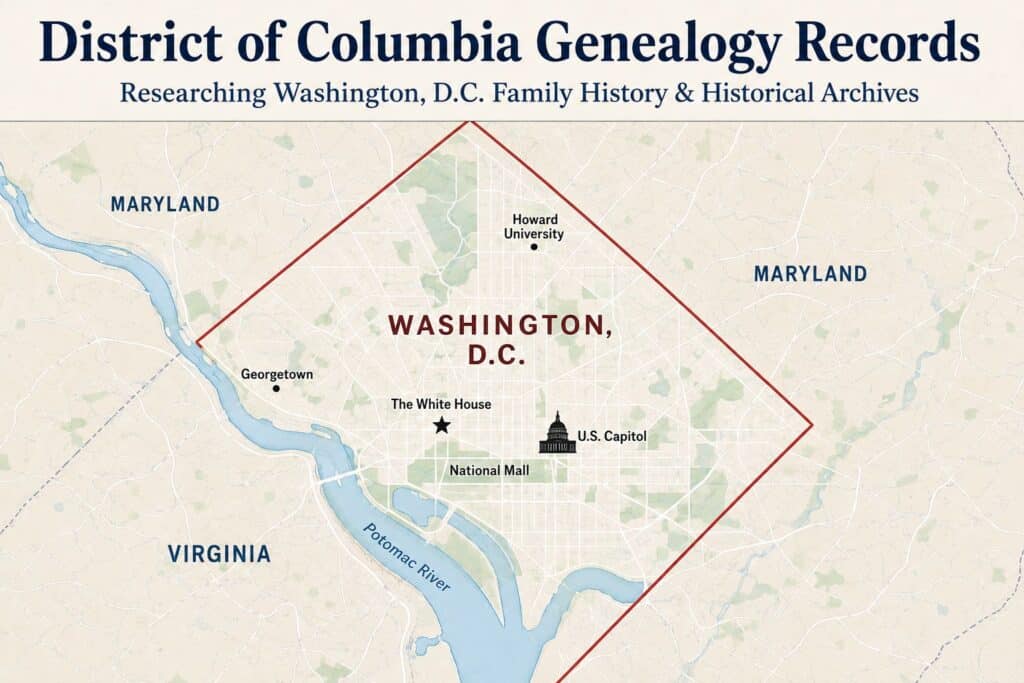
Researching family history in the District of Columbia offers a genealogy experience unlike any other place in the United States. Unlike the fifty states, the District of Columbia is a federal district established on July 16, 1790 to serve as the permanent capital of the young nation.
The district was created using land ceded by Maryland and Virginia, with a new federal city later constructed along the north bank of the Potomac River. Because of this unique origin, family historians often discover that records connected to Washington ancestors may appear in federal repositories as well as Maryland and Virginia archives depending on the time period being researched.
District of Columbia genealogy records provide access to generations of residents, government workers, immigrants, military personnel, merchants, and families who helped shape the nation’s capital. Understanding how D.C. developed historically makes tracing ancestors far easier and more accurate.
History of the District of Columbia
The creation of Washington, D.C. represented more than the establishment of a capital city—it created a distinct federal jurisdiction with its own historical record system.
President George Washington personally selected the capital region along the Potomac River. The area included nearby communities such as Georgetown in Maryland and surrounding rural settlements.
Before European settlement, Indigenous communities including the Nacotchtank and Piscataway peoples lived throughout the region and relied on the river system for trade and daily life. As European populations expanded through Maryland and Virginia during the colonial era, many Indigenous communities relocated into neighboring regions.
European settlers from England, Germany, Switzerland, and other parts of Europe gradually established communities across the surrounding territory during the 16th and 17th centuries.
The legal identity of Washington changed significantly after passage of the Organic Act of 1801. This law placed the territory under federal authority and ended the direct citizenship connection residents previously held with Maryland and Virginia. After that point, individuals living within the district became residents of a separate federal jurisdiction.
For genealogists, this distinction matters because records before and after 1801 may appear in entirely different archive systems.
Why District of Columbia Genealogy Is Unique
Researching ancestors in Washington requires a different strategy than researching traditional state records.
Multiple Jurisdictions Across Time
One of the most challenging parts of District genealogy is determining which government created the records.
Records may appear in:
- Maryland archives (before federal establishment)
- Virginia archives (historical territory records)
- Federal collections
- District of Columbia local archives
- National government collections
Understanding historical boundaries can prevent missing generations of family records.
Government Employment Patterns
Washington has always attracted residents connected to government service.
Many ancestors worked as:
- Federal employees
- Military personnel
- Contractors
- Clerks
- Politicians
- Service workers
- Construction laborers
Employment records often become important genealogy sources.
Migration Into the Capital
Washington developed into a destination city where families relocated from every region of the country and many international locations.
This migration pattern means family lines may appear in multiple states before arriving in D.C.
Population Growth and Demographic History
Population trends provide important context for genealogy research.
Population Milestones
| Year | Estimated Population |
|---|---|
| 1800 | 8,144 |
| 1850 | 51,600 |
| 1900 | 278,700 |
| 2010 | Approximately 600,000 |
As the federal government expanded, Washington transformed from a small administrative city into a major urban center.
African-American Genealogy in Washington, D.C.
African-American genealogy is especially significant in District of Columbia research.
Throughout the early nineteenth century, Washington maintained a large African-American population composed of both enslaved and free residents.
By 1860, approximately 80 percent of African-Americans in Washington were free Black residents, creating unusually rich historical opportunities for family research compared with many southern areas.
Washington continued to maintain a substantial Black population throughout the twentieth century. The percentage increased significantly and reached approximately 70 percent by 1970 before later demographic changes altered population distribution.
Researchers should explore:
- Freedmen records
- Census schedules
- Church records
- Employment files
- Property ownership documents
- Community newspapers
District of Columbia Genealogy Records to Search
Birth Records
Birth records can reveal:
- Parent names
- Addresses
- Occupations
- Dates and locations of birth
These records become especially valuable for connecting multiple generations.
Death Records
Death records often include:
- Cause of death
- Burial location
- Family informants
- Residence information
Marriage Records
Marriage documents frequently identify:
- Bride and groom
- Parents
- Occupations
- Witnesses
- Religious affiliation
Census Records
Federal census collections remain among the strongest resources for D.C. family history.
Census schedules help identify:
- Household composition
- Occupations
- Migration patterns
- Property ownership
Military Records
Military records may include:
- Service dates
- Pension files
- Draft registrations
- Veterans records
Probate and Court Records
Probate collections can reveal:
- Family relationships
- Property transfers
- Executors
- Guardianship arrangements
Land and Property Records
Property files help reconstruct where families lived and how wealth moved between generations.
Church and Cemetery Records
Religious institutions frequently preserved information unavailable elsewhere.
Useful records include:
- Baptisms
- Burials
- Marriage registers
- Membership lists
Immigration and Naturalization Records
Washington attracted immigrants throughout its history.
Naturalization records may contain:
- Birth locations
- Arrival dates
- Citizenship details
Newspaper Archives and City Directories
Directories and newspapers often provide:
- Addresses
- Occupations
- Obituaries
- Business listings
- Social announcements
Research Tips for Family Historians
Determine Which Jurisdiction Created the Record
Always identify whether the ancestor lived under Maryland, Virginia, District, or federal administration.
Search Historical Wards and Neighborhoods
Washington changed significantly over time.
Use:
- Historic ward maps
- City directories
- Census districts
Track Families Through Multiple Census Years
Comparing records decade by decade often reveals migration patterns and household changes.
Cross-Reference Government Employment Records
Federal employment records frequently connect individuals across decades.
Challenges in D.C. Family Research
Boundary Changes
Historical changes in territorial administration can make records difficult to locate.
Missing Records
Some historical collections are incomplete.
Name Variations
Names may appear differently across records.
Federal Record Complexity
Government employees may appear in multiple administrative collections.
Conclusion
District of Columbia genealogy records provide one of the most distinctive family history experiences in America. Because Washington developed as a federal district rather than a traditional state, researchers frequently encounter records spread across local, state, and national collections.
From Indigenous history and colonial settlement to federal expansion and demographic transformation, the District offers a unique lens into American family history. By understanding changing jurisdictions and combining census, vital, church, land, and archival records, genealogists can build a richer and more accurate picture of their Washington, D.C. ancestors.
Frequently Asked Questions
1. Is Washington, D.C. considered a state for genealogy?
No. Washington, D.C. is a federal district and not one of the fifty states.
2. Where are old D.C. records stored?
Records may appear in District repositories, federal archives, Maryland archives, and historical collections.
3. Can ancestors appear in Maryland or Virginia records?
Yes. Depending on the year, ancestors may appear in Maryland or Virginia collections before federal administration took effect.
4. What records are best for African-American genealogy?
Census records, church archives, Freedmen documentation, employment files, and property records often provide strong starting points.

I am Sandy Saga, the writer and content researcher behind FamilyTreeNow.net. I create clear, easy-to-understand informational content related to family history, people search resources, genealogy topics, and public information awareness. My goal is to help readers understand how online search tools and family research resources work in a simple and responsible way.
The content on FamilyTreeNow.net is published strictly for informational and educational purposes only. I focus on providing accurate, transparent, and reader-friendly information to help users explore and learn. This website does not offer official records, legal advice, or professional services — it exists solely as an independent informational resource.