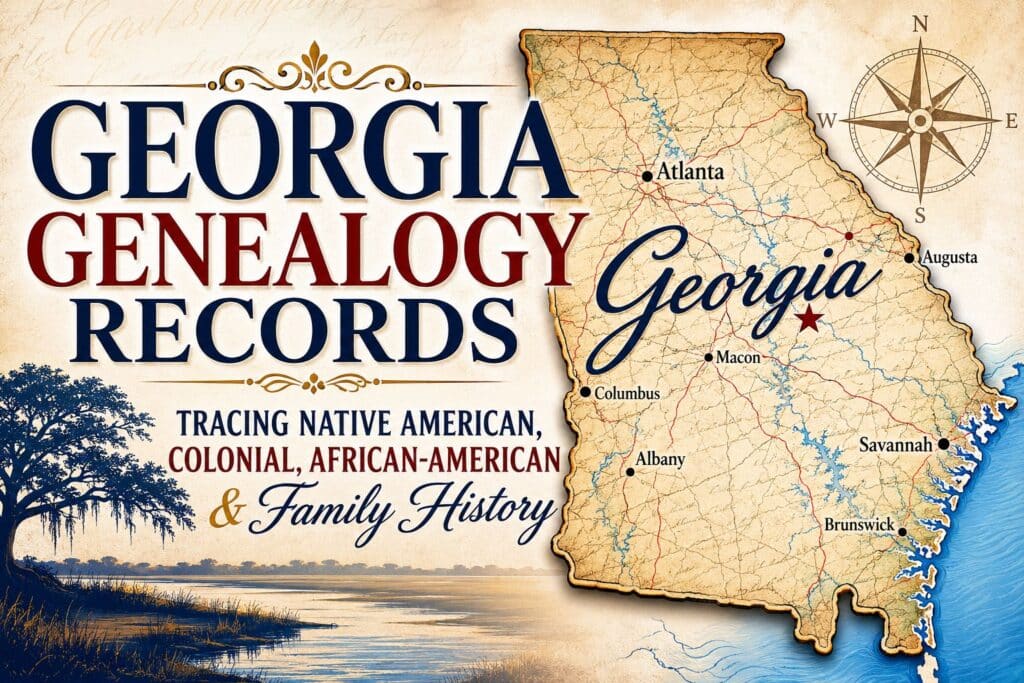
Georgia offers one of the richest historical landscapes for family history research in the United States. From Indigenous civilizations and European settlement to African-American heritage and large migration movements, the state provides generations of records that can help uncover ancestral stories.
For genealogists, Georgia represents far more than names and dates. The state’s development was shaped by Native American communities, colonial expansion, slavery, agricultural growth, war, industrial change, and population migration. Each era created records that remain valuable today.
Whether your ancestors lived among Cherokee communities, arrived as English colonists, worked plantations along the coast, migrated westward during the nineteenth century, or relocated north during the twentieth century, understanding Georgia’s historical timeline can make genealogy research more effective.
This guide explores Georgia genealogy records and the historical events that influenced where records were created—and where descendants can search today.
Native American Origins in Georgia
Long before European settlement, Georgia was occupied by Indigenous societies that developed advanced communities across the region. Archaeological evidence suggests organized Native cultures existed in the region between approximately 1000 BC and 1000 AD.
For family historians researching Georgia ancestry records, Native American history is essential because tribal movements strongly influenced later settlement patterns and population records.
Cherokee Nation
The Cherokee occupied broad territories extending beyond modern Georgia into surrounding regions. Although many people associate Cherokee history with North Georgia, historical Cherokee influence reached across parts of the southeastern United States.
Cherokee settlements were often established in mountain and river areas that supported agriculture and transportation.
Researchers tracing Cherokee ancestry should review:
- Tribal enrollment records
- Census collections
- Land cession records
- Treaty documentation
- Migration and relocation records
- Mission and church archives
Because tribal boundaries changed over time, genealogy researchers should search surrounding states in addition to Georgia.
Creek Confederacy: Upper and Lower Creek
The Creek people represented one of the most influential Indigenous groups in Georgia history.
Communities developed along major waterways including:
- Flint River
- Chattahoochee River
- Coosa River
- Alabama River
- Ocmulgee River
River settlements became important markers for later colonial expansion and record creation.
Genealogists researching Creek ancestry should investigate military records, treaty documents, mission records, and county land transfers.
Yamasee and Yamacraw Communities
The Yamasee established settlements primarily near the Savannah River region and coastal Georgia.
Conflict between colonial powers eventually displaced many communities. Some Yamasee groups migrated south while others merged with Creek populations and contributed to the formation of the Yamacraw community.
These population shifts can create challenges for genealogy because families may appear under different tribal identities across records.
Early European Settlement & Colonial Georgia
European exploration dramatically transformed Georgia’s demographic history and permanently changed the records available to descendants.
Spanish Exploration Begins (1526)
The earliest known European attempt to establish a permanent presence in Georgia occurred in 1526 when Spanish explorer Lucas Vásquez de Ayllón attempted settlement along the Georgia coast near present-day St. Catherines Island.
Although unsuccessful, these early expeditions marked the beginning of European influence.
Additional Spanish exploration expanded inland over the following decades.
French Settlement Attempts
By the mid-sixteenth century, French colonists attempted settlements farther north along the Atlantic coast.
These efforts ultimately failed but reflected growing European competition for southeastern territories.
Although records from these settlements are limited, they remain useful for understanding early migration patterns.
Disease and Population Change
European arrival brought major population disruption among Native communities.
Exposure to unfamiliar diseases reduced Indigenous populations and altered tribal settlement structures across Georgia.
For genealogists, this means some Native family lines may disappear from one region and later reappear elsewhere under different community identities.
English Expansion into Georgia
By the late seventeenth century, English traders moved into Georgia seeking opportunities through trade and regional influence.
Trading posts and forts became centers for documentation and created some of the earliest colonial records.
Interactions with Indigenous groups generated:
- Trade records
- Land agreements
- Settlement maps
- Colonial correspondence
These materials remain valuable for historical family reconstruction.
The Founding of Savannah (1733)
One of the most important events in Georgia genealogy occurred on February 12, 1733, when settlers arrived at present-day Savannah.
This marked the formal beginning of Georgia’s English colonial era.
Savannah quickly developed into a major administrative and migration center.
Researchers with colonial Georgia ancestry should prioritize:
- Port arrival records
- Colonial land grants
- Tax records
- Church registries
- Early census substitutes
James Edward Oglethorpe and Colonial Vision
Georgia’s founding is closely connected to James Edward Oglethorpe, whose vision was to establish a colony that provided opportunity for people experiencing financial hardship in England.
The original concept emphasized structured settlement and productive communities.
Over time, however, Georgia’s economy shifted toward plantation agriculture and labor expansion.
These economic changes would significantly shape the state’s future records and population history.
African-American Genealogy in Georgia
African-American genealogy forms one of the most important dimensions of Georgia family history.
Beginning in the eighteenth century, slavery expanded rapidly across the colony and later state, creating generations of historical records that remain essential for ancestry research.
African-American Genealogy in Georgia
Between 1750 and 1775, Georgia experienced rapid economic growth driven largely by agriculture. During this period, the importation of enslaved Africans increased dramatically, transforming the population and creating one of the most significant areas of genealogy research in the state.
Historical estimates show Georgia’s enslaved population expanded rapidly during the colonial period, becoming deeply connected to the development of farming, trade, and coastal communities.
For descendants researching African-American genealogy in Georgia, understanding where ancestors lived and worked can reveal important historical records.
Origins of Enslaved Africans in Georgia
Many enslaved Africans brought into Georgia originated from regions along the West African coast, including areas associated with present-day:
- Sierra Leone
- Gambia
- Angola
Although exact origins are often difficult to document due to incomplete records, shipping records, plantation documents, and later census records may provide clues.
Researchers should consider:
- Plantation account books
- Estate inventories
- Bills of sale
- Church records
- Probate files
- Agricultural records
Because enslaved individuals were often listed only by first name, combining multiple record sources becomes essential.
Cultural Development Along Georgia’s Coast
African influence became deeply embedded in Georgia’s culture, especially in coastal regions.
Generations of African-descended communities preserved traditions through:
- Language
- Music
- Food
- Storytelling
- Religious practices
- Agricultural knowledge
Today, cultural continuity remains visible in parts of coastal Georgia and can provide context for family historians tracing ancestral communities.
Reconstruction and African-American Migration
Following emancipation, many formerly enslaved individuals relocated from plantations to towns and growing cities.
Urban areas such as Atlanta and Savannah became important destinations for employment and rebuilding family life.
Important genealogy sources after emancipation include:
- Freedmen’s records
- Voter registrations
- City directories
- Employment records
- School records
- Church memberships
- Marriage registrations
These records frequently contain family relationships absent from earlier documents.
Revolutionary War Through Statehood
Georgia played an active role during the American Revolution and experienced substantial population changes.
Georgia During the Revolutionary Era
When the colonies moved toward independence in 1775, Georgia joined the revolutionary movement.
Savannah became strategically important during the conflict.
For genealogy researchers, war periods often generate valuable documentation including:
- Military service files
- Pension applications
- Land grants
- Tax assessments
- Local militia records
Movement of Enslaved Populations
During wartime, some enslaved individuals escaped and sought opportunities under British protection after promises of freedom.
These movements created population changes that sometimes placed individuals into records outside Georgia.
Researchers should expand searches into neighboring states and British military collections where available.
Georgia Becomes a State
Georgia officially entered the Union on January 2, 1788.
Following statehood, agriculture expanded rapidly.
Cotton production influenced migration and land ownership patterns, increasing the amount of documentation available to descendants.
Useful records from this era include:
- State censuses
- Tax lists
- County court files
- Property records
- Agricultural schedules
Cherokee Removal & Migration Patterns
One of the most significant events affecting Georgia genealogy occurred during the nineteenth century.
Georgia Gold Rush (1829)
The discovery of gold in northern Georgia attracted settlers and accelerated pressure for expansion.
Population growth transformed land ownership and altered Indigenous territories.
Gold rush records may include:
- Land lotteries
- Mining claims
- Settlement maps
- Tax lists
Indian Removal Act (1830)
Federal removal policies reshaped genealogy across the southeastern United States.
Families that had lived in Georgia for generations were relocated westward.
Historical movement created records that now appear across multiple states.
Researchers tracing Indigenous ancestry should investigate:
- Removal rolls
- Treaty records
- Reservation documents
- Federal relocation files
- Tribal enrollment collections
Cherokee Displacement to Oklahoma
By 1838, forced relocation moved many Cherokee families from Georgia to western territories.
This migration created long-distance family movements that researchers must account for.
If family lines disappear from Georgia records during the 1830s, continue research in Oklahoma and associated tribal archives.
Civil War, Reconstruction & Population Change
The Civil War permanently changed Georgia’s social and genealogical landscape.
Georgia and Secession
Georgia became one of the Confederate states in January 1861.
Military campaigns and destruction across the state disrupted communities and record preservation.
Civil War researchers should search:
- Confederate service records
- Union military records
- Pension applications
- County archives
- Cemetery collections
Population Changes After Emancipation
Following the war, many African-American families sought greater opportunities in growing urban centers.
Atlanta and Savannah expanded as economic centers.
Researchers should compare:
- 1870 census records
- City directories
- Employment records
- Property ownership records
The 1870 federal census is especially important because it was the first census to broadly identify formerly enslaved individuals by name.
Economic and Social Transformation
By the late nineteenth century, Georgia began transitioning through industrial development and economic modernization.
Lumber, manufacturing, agriculture, and transportation networks encouraged additional migration.
Some Georgia families moved into:
- Florida
- Alabama
- Tennessee
- Northern industrial states
Tracking migration routes often reveals previously hidden branches of a family tree.
Georgia Genealogy Records to Search
Understanding Georgia’s historical background becomes far more valuable when combined with actual records. Every generation left behind documents that can help reconstruct family relationships, migration paths, occupations, and community connections.
Below are the most useful Georgia genealogy records to search.
Birth Records
Georgia birth records can provide:
- Full name
- Date and place of birth
- Parents’ names
- Residence information
- Occupations in some cases
Researchers should remember that statewide registration practices improved over time, so earlier records may require searching county sources and church archives.
Death Records
Death records are often among the most informative genealogy resources.
They may include:
- Date and location of death
- Parents’ names
- Spouse information
- Burial location
- Informant details
Obituaries and cemetery records can often supplement missing death certificates.
Marriage Records
Marriage documents frequently reveal family connections not visible elsewhere.
Search for:
- Marriage licenses
- Marriage bonds
- Church marriage registers
- County marriage books
Women may appear under maiden names in earlier records, making marriage records especially valuable.
Census Records
Census records remain one of the strongest foundations for Georgia family history research.
Censuses can help identify:
- Household members
- Approximate birth years
- Occupations
- Property ownership
- Migration timing
Compare multiple decades to identify changes in family structure.
Land Records
Land ownership records can reveal generations of family movement.
Search:
- Deeds
- Land grants
- Survey maps
- Tax digests
- Property transfers
Land records become especially useful before statewide vital registration.
Probate Records
Probate files often contain rich family detail.
Useful documents include:
- Wills
- Estate inventories
- Guardianship records
- Executor documents
- Distribution records
Probate documents can reveal relationships spanning several generations.
Military Records
Military service created extensive documentation.
Search records connected to:
- Revolutionary War
- War of 1812
- Civil War
- Spanish–American War
- World Wars
Military files frequently include birth information, residences, dependents, and pension applications.
Church Records
Church collections are essential for early Georgia research.
Look for:
- Baptisms
- Membership lists
- Marriages
- Burial records
- Community directories
Church archives may preserve records older than civil registration systems.
Immigration Records
Although Georgia was not historically the largest immigration gateway, migration into the state generated valuable documentation.
Useful sources include:
- Passenger arrivals
- Port records
- Naturalization documents
- Settlement records
Combine immigration records with census schedules for better accuracy.
Newspapers & Obituaries
Historical newspapers often fill gaps left by official records.
Search for:
- Obituaries
- Marriage announcements
- Community notices
- Military reports
- Business notices
Small local newspapers frequently contain details unavailable elsewhere.
Cemetery Records
Cemetery research helps connect generations.
Useful details may include:
- Family plots
- Birth and death dates
- Religious affiliation
- Military service markers
Always compare cemetery information with official documents.
Research Tips for Georgia Family History
Genealogy research becomes more successful when historical context is included alongside documents.
Track County Boundary Changes
Georgia counties changed over time.
A family may appear in multiple counties without ever relocating.
Always verify historical county maps.
Search Alternate Name Spellings
Spelling variations were common.
Try:
- Alternate surnames
- Phonetic spellings
- Initials
- Nicknames
Do not assume records will match modern spelling.
Combine Census Records with Local Archives
Census records provide structure but rarely tell the full story.
Combine them with:
- Tax records
- Newspapers
- Churches
- Probate files
- Local histories
Follow Migration Patterns
Understanding movement patterns often explains missing records.
Consider:
- Native displacement
- Colonial settlement
- Agricultural expansion
- Postwar migration
- Urban movement
Family history becomes clearer when records and migration timelines align.
Conclusion
Researching Georgia genealogy records is more than collecting names and dates—it is understanding the historical forces that shaped generations of families.
From Native American communities and colonial settlement to African-American heritage, migration movements, industrial growth, and modern population changes, Georgia’s history created an extraordinary collection of records for family researchers.
Every census entry, land transfer, church register, military file, and newspaper article tells part of a larger story.
By combining historical context with official genealogy records, researchers can move beyond basic family trees and preserve the experiences, movements, and legacy of generations that helped shape Georgia.
Start with what you already know, document each discovery carefully, and continue building a Georgia family history that future generations can inherit and understand.
Frequently Asked Questions
1. How far back do Georgia genealogy records go?
Some Georgia historical records trace back to colonial settlement in the eighteenth century. Church documents, land grants, and local archives may provide evidence earlier than official state records.
2. How can I trace Native American ancestry in Georgia?
Begin with family documents and census records, then compare findings with tribal records, treaty collections, relocation documents, and historical land records.
3. Where can I find African-American genealogy records?
African-American genealogy research may include census schedules, church archives, probate files, military records, post-emancipation collections, and local historical sources.
4. What records help trace Georgia families before 1800?
Useful sources include:
- Colonial land grants
- Church records
- Tax lists
- Probate files
- Military documents
- Early settlement records

I am Sandy Saga, the writer and content researcher behind FamilyTreeNow.net. I create clear, easy-to-understand informational content related to family history, people search resources, genealogy topics, and public information awareness. My goal is to help readers understand how online search tools and family research resources work in a simple and responsible way.
The content on FamilyTreeNow.net is published strictly for informational and educational purposes only. I focus on providing accurate, transparent, and reader-friendly information to help users explore and learn. This website does not offer official records, legal advice, or professional services — it exists solely as an independent informational resource.