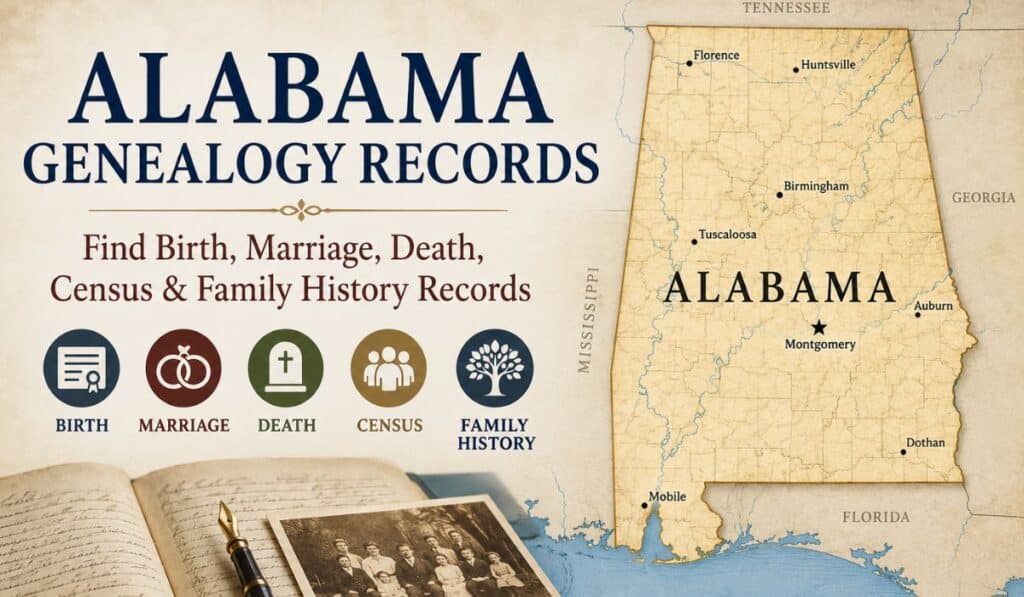
Understanding the history of Alabama helps explain where family records were created, why some records are missing, and how ancestors moved across the region over time.
Alabama’s genealogy story began long before statehood. European exploration reached the region during the early 1500s, when Spanish expeditions documented portions of what later became the southeastern United States. Over the following centuries, Spain, France, and Great Britain each controlled different parts of the land that would eventually become Alabama.
By the early 1700s, permanent European settlements began developing near present-day Mobile. As colonial powers changed through military conflicts and territorial agreements, settlement patterns shifted repeatedly. These transitions affected land ownership, church registration systems, court jurisdictions, and ultimately the records genealogists rely on today.
Native American Territories and Early Settlement Expansion
Before large-scale European settlement, Alabama was home to Native American nations including the Choctaw, Chickasaw, Creek, and Cherokee peoples.
As new settlers moved into the region during the late eighteenth and early nineteenth centuries, federal expansion policies led to the gradual displacement of many Native communities. These migration events remain important for genealogy research because records relating to tribal communities, land transfers, and relocations may appear in federal collections rather than local Alabama records.
Researchers tracing Native ancestry often need to combine:
- Tribal records
- Land records
- Treaty documentation
- Military records
- Federal census collections
Alabama’s Territorial Origins
Before becoming a state, Alabama passed through multiple jurisdictions.
Historically, portions of Alabama were connected to:
- Colonial territorial claims
- Mississippi Territory
- Georgia land cessions
- Spanish West Florida
Because of these administrative changes, some early Alabama ancestors may appear in records located outside modern state boundaries.
A common genealogy mistake is searching only Alabama repositories when an ancestor’s records may actually exist in Georgia, Mississippi, or federal territorial collections.
Statehood and Rapid Population Growth (1817–1850)
Alabama officially became a U.S. territory in 1817 and achieved statehood on December 14, 1819.
During the early nineteenth century, population growth accelerated as migrants arrived from older Atlantic states seeking farmland and economic opportunity.
Between approximately 1805 and 1835, many settlers migrated from:
- Georgia
- Virginia
- North Carolina
- South Carolina
- Tennessee
This migration pattern explains why Alabama family history records often connect directly to neighboring southern states.
The state capital also changed during this period:
- St. Stephens served as the territorial capital
- Tuscaloosa later became the state capital
- Montgomery eventually became the permanent capital
Each administrative change influenced where historical government records were maintained.
Alabama Census Growth and What It Means for Genealogy
Population expansion created increasingly detailed census and local government records.
Approximate historical population growth:
| Census Year | Estimated Population | Genealogy Significance |
|---|---|---|
| 1830 | 309,000 | Early settlement tracking |
| 1850 | 771,000 | Expanded household identification |
| 1870 | 990,000 | Reconstruction-era family research |
| 1880 | 1.26 million | Industrial migration evidence |
| 1900 | 1.83 million | More stable civil registration |
These population increases created larger volumes of:
- Census schedules
- Marriage records
- Probate files
- Property deeds
- Court records
- Newspaper notices
Civil War and Reconstruction Records
Alabama’s Civil War period created a major division in family history research.
Alabama seceded from the Union in January 1861 and became an important Confederate state. Military service records, pension applications, casualty records, and post-war rebuilding documents are valuable sources for tracing ancestors from this era.
After rejoining the Union in 1868, political and social changes expanded record creation and civic participation.
Researchers studying ancestors from this period should prioritize:
- Military files
- Pension records
- County court records
- Tax lists
- Reconstruction-era census schedules
Industrial Growth and Migration Patterns (1880–1965)
By the late nineteenth century, Alabama experienced rapid industrial growth.
Cities expanded through:
- Iron production
- Steel manufacturing
- Shipbuilding
- Transportation networks
At the same time, migration continued both into and out of Alabama.
Some long-established families relocated to:
- Texas
- Louisiana
- Arkansas
- Industrial regions outside the South
This movement explains why Alabama ancestry records frequently connect with records from other states.
During the twentieth century, economic changes, urban growth, and civil rights developments shaped record keeping even further.
For genealogists, understanding migration timelines often becomes the key to locating missing relatives.
Why Alabama History Matters for Family Tree Research
Historical context transforms genealogy from collecting names into understanding how families lived and moved.
When researching Alabama genealogy records:
- Search neighboring states for earlier generations
- Consider changing county boundaries
- Review migration periods
- Study local economic history
- Compare census, land, and probate records
Family history research becomes more accurate when historical events are used alongside official records.
The most successful Alabama genealogy projects combine historical context with documented evidence to build reliable family trees across generations.

I am Sandy Saga, the writer and content researcher behind FamilyTreeNow.net. I create clear, easy-to-understand informational content related to family history, people search resources, genealogy topics, and public information awareness. My goal is to help readers understand how online search tools and family research resources work in a simple and responsible way.
The content on FamilyTreeNow.net is published strictly for informational and educational purposes only. I focus on providing accurate, transparent, and reader-friendly information to help users explore and learn. This website does not offer official records, legal advice, or professional services — it exists solely as an independent informational resource.