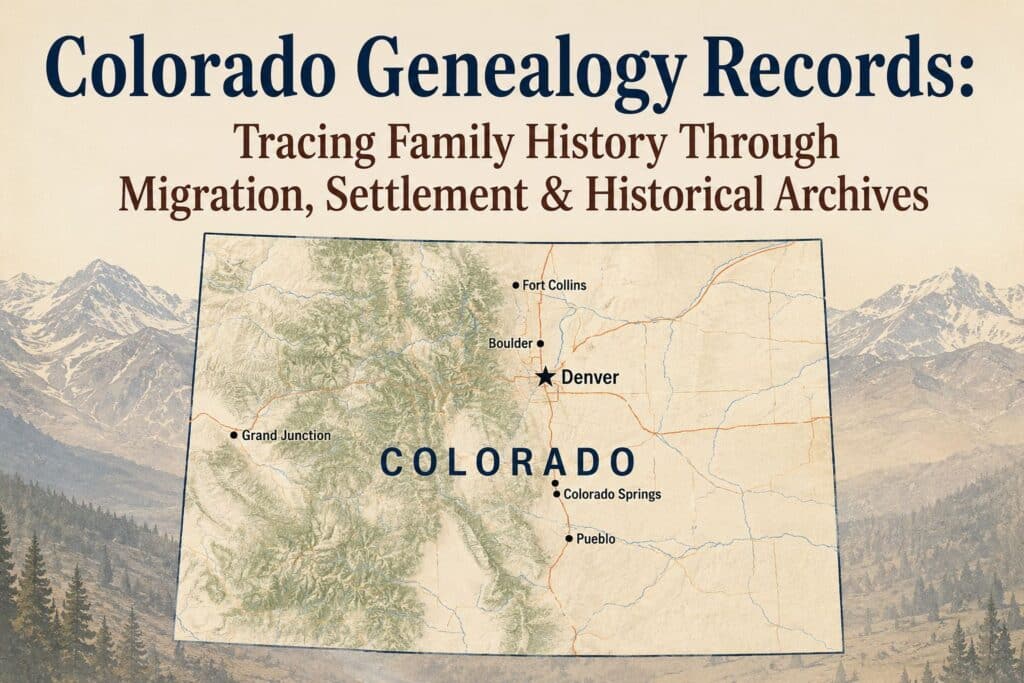
Researching Colorado genealogy records offers far more than names and dates—it reveals the movement of people, the growth of communities, and the historical events that shaped generations of families. Colorado’s story includes Native American history, Spanish and Mexican influence, mining booms, railroad expansion, international immigration, and agricultural settlement. Each period left behind valuable historical records that modern family researchers can use to trace ancestry.
For those building a Colorado family tree, understanding when and why people arrived in the region can dramatically improve research results. Migration patterns often explain where records were created, which counties hold archives, and how family lines spread across neighboring states.
Whether your ancestors came during the gold rush era, arrived through railroad expansion, or settled as immigrant farming communities, Colorado offers a rich collection of historical documents for genealogy research.
Geography and Early Settlement of Colorado
Colorado’s landscape played a major role in determining settlement patterns and ultimately the records available to genealogists today.
The western region is dominated by the Rocky Mountains, one of North America’s most recognizable mountain systems. These mountains contain abundant natural resources including silver and gold, both of which influenced migration into the region. East of the Rockies, broad plains and fertile croplands encouraged agricultural development.
Understanding geography is important in genealogy because historical records frequently followed economic activity. Mining regions generated land claims, employment records, court filings, and population growth, while farming areas produced property records, census entries, and community documentation.
Spanish and Mexican Influence
Long before Colorado became a U.S. state, the territory formed part of Spanish colonial holdings beginning in the seventeenth century. Control later shifted under Mexican governance during the early nineteenth century.
These early administrations influenced naming conventions, land grants, religious records, and settlement structures that continue to affect genealogy research today.
Researchers tracing Hispanic ancestry in Colorado often encounter:
- Spanish land records
- Catholic church registers
- Baptism documents
- Marriage records
- Settlement records
- Colonial administrative archives
Many of these documents predate formal U.S. government recordkeeping and may contain valuable family connections.
San Luis Valley and Early Permanent Settlement
One of the earliest permanent non-Indigenous settlements in Colorado developed in the San Luis Valley.
The town of San Luis, founded in 1851, became Colorado’s first permanent white settlement. This region remains historically important because early settlers often generated church records, land transactions, and community registrations.
Genealogists researching southern Colorado frequently discover:
- Early land ownership files
- Church documentation
- Family migration records
- Agricultural community records
Because settlement in this area predates Colorado statehood, records may appear under different governmental jurisdictions.
Migration Patterns That Shaped Colorado Genealogy
Colorado genealogy research becomes much easier when researchers understand migration history.
Unlike older eastern states where settlement occurred gradually, Colorado experienced rapid population surges tied directly to economic opportunities.
Gold Discovery Near Denver (1858)
The discovery of gold near Denver in 1858 transformed Colorado from a sparsely populated frontier into a destination for permanent settlement.
Initially, many travelers heading west toward California and Oregon simply passed through Colorado. Gold changed that pattern.
Families and individuals suddenly arrived with the intention of remaining permanently.
This migration created new historical records including:
- Land ownership filings
- Property transactions
- Mining registrations
- Business licenses
- Local newspapers
- Marriage documentation
These records now form an important part of Colorado ancestry research.
Pike’s Peak Gold Rush (1859)
Only one year later, another major event accelerated migration—the Pike’s Peak Gold Rush.
The famous phrase “Pike’s Peak or Bust” attracted thousands of newcomers.
Population growth during this period produced:
- Expanded census records
- Territorial registrations
- Tax records
- Mining documentation
- Community directories
Gold rush populations also created temporary settlements that later evolved into permanent communities.
Colorado Territory Formation (1861)
Colorado officially became a United States territory in 1861.
At that time the population reached approximately 34,000 residents, many of whom were young men seeking economic opportunity.
Migration patterns show many settlers originated from:
- Ohio
- Illinois
- Missouri
- Indiana
This movement matters for genealogy because families often appear in multiple states across consecutive census years.
Researchers should search earlier records in eastern states before assuming Colorado was the starting point of residence.
Native American History and Colorado Records
Colorado genealogy cannot be fully understood without recognizing Indigenous history.
Long before European settlement, the region was inhabited by Native communities including:
- Ute
- Apache
- Cheyenne
- Arapaho
- Sioux
Historical changes involving tribal lands directly influenced settlement records and population movement.
Land Changes and Settlement Expansion
In February 1861, portions of Cheyenne and Arapaho territory near Pike’s Peak transferred to United States control.
Additional Ute lands east of the Continental Divide were relinquished in 1864.
By 1881, relocation of Ute communities opened large portions of western Colorado to expanded settlement.
For genealogy researchers, these transitions affected:
- Land ownership records
- Federal documentation
- Reservation records
- Military reports
- Population distribution
Researchers with Indigenous ancestry should examine tribal archives in addition to standard state records.
Railroads, Mining, and Population Growth
Colorado’s next major transformation came through transportation.
Railroad expansion beginning in 1869 created one of the largest population increases in state history.
People from eastern states, including those recovering from post-war economic disruption, moved west seeking opportunity.
Between 1870 and 1875, Colorado’s population nearly tripled.
Railroads influenced genealogy because they generated:
- Employment records
- Passenger records
- Town directories
- Property development files
- Railroad company documentation
Mining and Agriculture
Colorado’s economy during this period relied heavily on two industries:
Mining
Mining created extensive documentation through:
- Claims
- Employment records
- County filings
- Business registrations
Agriculture
Agriculture produced:
- Land ownership records
- Tax records
- Census entries
- Community directories
These industries generated records that remain highly useful for modern family history research.
Colorado Statehood
Colorado officially became the 38th U.S. state on August 1, 1876.
Statehood expanded government recordkeeping and improved consistency across counties.
For genealogists, records after statehood generally become easier to locate and verify.
Immigration and Ethnic Communities in Colorado
Colorado’s population growth did not come only from migration within the United States. International immigration also played a major role in shaping the state’s cultural identity and creating diverse genealogy records.
By the late nineteenth century, Colorado had become attractive to both domestic settlers and foreign-born populations seeking land, employment, mining opportunities, and economic stability.
Genealogy researchers should understand that immigrant communities often maintained their own institutions and records before becoming fully integrated into state and county systems.
Domestic Migration Across the United States
As Colorado developed, additional settlers arrived from:
- New York
- Pennsylvania
- Nebraska
- Kansas
- Missouri
- Iowa
Families moving west frequently left records in multiple locations.
Researchers should search for:
- Federal census records
- County tax records
- Property transfers
- Railroad settlement documentation
- Probate files
- Family newspapers
A family appearing in Colorado in 1880 may still have records in Pennsylvania or Missouri only a few years earlier.
International Immigration into Colorado
Colorado became increasingly popular among foreign-born communities.
Significant immigrant populations arrived from:
- Germany
- Russia
- Ireland
- Sweden
- Canada
- Scotland
- Italy
- China
By the 1880s, nearly one-fifth of Colorado’s population had been born outside the United States.
Each immigrant group left different types of genealogy sources.
Examples include:
German Communities
German settlement expanded heavily in eastern Colorado during the 1890s.
Useful records include:
- Lutheran church records
- Farming settlements
- Immigration documents
- Community newspapers
Irish Families
Irish immigrants commonly worked in mining and railroads.
Helpful records:
- Employment records
- Catholic church records
- Census records
Chinese Communities
Chinese populations often participated in labor industries and local commerce.
Researchers may examine:
- Community directories
- Immigration records
- Historical newspapers
Hispanic Communities and Early Settlers
Southern Colorado contains a strong population of Hispanos—descendants of early Mexican settlers with colonial Spanish roots.
These families often maintained records through:
- Catholic churches
- Local settlements
- Family registries
- Land grants
Today, Hispanic communities continue to represent a significant portion of Colorado’s population and remain an important area of genealogy research.
Asian-American Communities
Colorado also developed substantial Asian-American communities.
Researchers tracing ancestry may encounter records associated with:
- Chinese heritage
- Japanese communities
- Filipino populations
- Korean immigration
Community organizations and local archives can provide valuable supplemental information.
Population Growth and Historical Context
Colorado’s population growth demonstrates how rapidly settlement occurred:
- 1861: approximately 34,000 residents
- 1900: approximately 539,700 residents
- 1930: approximately 1,035,000 residents
Population growth created expanding government documentation and increasingly detailed historical records.
Key Colorado Genealogy Records to Search
Finding ancestors depends on searching the right record categories.
Birth Records
Birth records may reveal:
- Full legal names
- Parent information
- Birth locations
- Family residences
These are often foundational documents for family trees.
Marriage Records
Marriage records frequently include:
- Bride and groom details
- Witness names
- Parent information
- Occupations
Death Certificates
Death records can provide:
- Birthplace
- Cause of death
- Parent names
- Burial locations
Census Records
Census collections remain among the most valuable genealogy tools.
They may show:
- Household members
- Occupation
- Birth state
- Immigration status
- Property ownership
Land Ownership Records
Land records often connect generations and show movement across counties.
Useful documents include:
- Deeds
- Homestead filings
- Property transfers
Mining Records
Colorado’s mining history created unique genealogy opportunities.
Look for:
- Mining claims
- Employment files
- Local court records
Immigration Records
Immigration documents may include:
- Arrival information
- Naturalization
- Country of origin
Military Records
Military files can reveal:
- Service details
- Family relationships
- Residence history
Newspaper Archives
Historic newspapers may contain:
- Obituaries
- Marriage announcements
- Business notices
- Community updates
Church and Cemetery Records
Religious records often predate civil registration.
Search for:
- Baptisms
- Marriages
- Funeral records
- Burial indexes
Probate and Court Records
Probate documents may reveal:
- Family relationships
- Property distribution
- Legal guardianship
Best Sources for Colorado Family Research
Successful genealogy depends on using multiple record collections.
State Archives
State-level archives preserve:
- Historical records
- Government collections
- Land documentation
County Offices
Many genealogy records remain local.
County offices often maintain:
- Birth certificates
- Marriage licenses
- Property records
Historical Societies
Historical organizations preserve:
- Local histories
- Family collections
- Historical maps
Online Genealogy Databases
Digital resources continue making family research easier through searchable databases and scanned archives.
Public Family Record Collections
Public genealogy collections can help connect records across generations and locations.
Tips for Building Your Colorado Family Tree
Genealogy research becomes more accurate when approached systematically.
Verify Names and Dates
Historical spelling differences are common.
Compare multiple records before drawing conclusions.
Search Neighboring States
Colorado families frequently migrated from nearby and eastern states.
Expand searches beyond Colorado alone.
Track Migration Routes
Understanding settlement routes can reveal where additional records exist.
Document Multiple Sources
Record:
- Archive names
- Dates
- Collection details
- Supporting evidence
Good documentation strengthens long-term family research.
Conclusion
Colorado genealogy records reflect one of America’s most dynamic settlement histories.
From Spanish and Mexican influence to gold rush expansion, railroad development, and international immigration, each period created records that remain valuable for family historians today.
Whether tracing miners who arrived during the Pike’s Peak era, farming communities in eastern Colorado, immigrant families seeking opportunity, or descendants of early Hispanic settlements, Colorado offers extensive historical resources for discovering ancestral connections.
By combining historical context with birth, marriage, death, land, census, church, and immigration records, researchers can build a stronger and more accurate Colorado family tree that preserves generations of family history.

I am Sandy Saga, the writer and content researcher behind FamilyTreeNow.net. I create clear, easy-to-understand informational content related to family history, people search resources, genealogy topics, and public information awareness. My goal is to help readers understand how online search tools and family research resources work in a simple and responsible way.
The content on FamilyTreeNow.net is published strictly for informational and educational purposes only. I focus on providing accurate, transparent, and reader-friendly information to help users explore and learn. This website does not offer official records, legal advice, or professional services — it exists solely as an independent informational resource.