Florida’s story is unlike that of most American states. Long before becoming part of the United States, the peninsula passed through multiple colonial powers, experienced centuries of migration, and became home to Indigenous communities, European settlers, Caribbean immigrants, and people relocating from nearly every region of North America.
For genealogy researchers, this layered history creates both opportunity and complexity.
Tracing Florida ancestors often means working across Spanish, British, and American historical periods while understanding changing borders, languages, record systems, and migration patterns. Family lines may appear in Spanish church records, British land grants, military files, territorial censuses, immigration records, and local archives.
Modern Florida family research is strengthened when historical context is combined with traditional genealogical methods.
Early Colonial Florida (1513–1763)
Juan Ponce de León and the Naming of Florida
Florida entered recorded European history in 1513 when Spanish explorer Juan Ponce de León arrived on the peninsula. He named the territory “La Florida,” commonly interpreted as “Land of Flowers.”
This marked the beginning of more than two centuries of Spanish influence.
Early records from this period are among the oldest European records in North America and may include:
- Church baptism records
- Marriage registers
- Land grants
- Colonial administration records
- Military documentation
These materials remain valuable resources for tracing some of Florida’s earliest families.
Spanish Colonization and Settlement
Spain viewed Florida as strategically important for controlling maritime routes and protecting colonial territories.
By the mid-1500s, settlements and military positions expanded across the region.
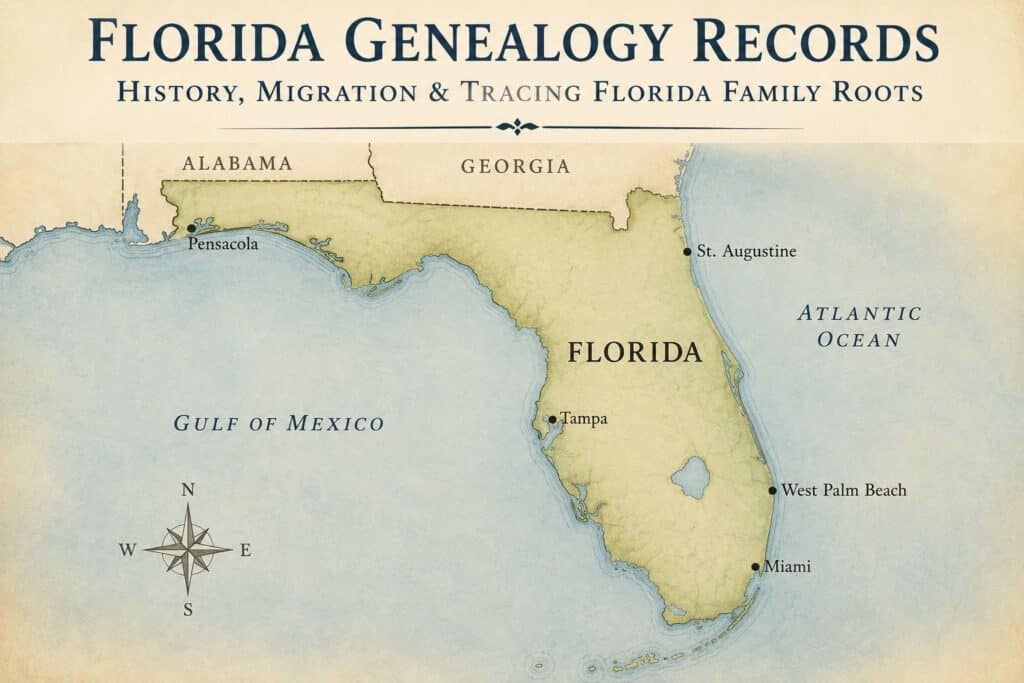
One of the most significant developments was the establishment of St. Augustine in 1565. The settlement became the oldest continuously occupied European-established city in the continental United States.
During Spanish rule, Florida extended far beyond today’s boundaries and included influence across portions of the southeastern United States.
French Settlement Attempts and Territorial Conflict
European powers competed intensely for control.
French Huguenots attempted to establish Fort Caroline near present-day Jacksonville in 1564. Spain quickly responded and removed the French presence to secure the region.
These conflicts shaped settlement locations and influenced where records and family histories emerged.
For genealogists, colonial movement often explains why early ancestors appear in multiple regions despite never physically relocating.
British Florida Period (1763–1783)
East Florida and West Florida
Following conflict between European powers, Spain transferred Florida to Britain in 1763.
The British divided the territory into:
- East Florida
- West Florida
This administrative change altered land ownership, legal systems, and record keeping.
Settlement Growth and Land Grants
British authorities encouraged immigration through land incentives.
New settlers arrived seeking opportunity and security.
Records from this era commonly include:
- Property transactions
- Tax lists
- Settlement documents
- Colonial correspondence
- Military records
Loyalist Migration
During the American Revolutionary War, Florida became a refuge for individuals loyal to Britain.
Many Loyalist families relocated into Florida and later moved again after the war.
Researchers tracing southeastern family lines frequently encounter ancestors crossing between Georgia, the Carolinas, and Florida.
Spanish Return and Transfer to the United States (1784–1821)
After Britain’s defeat, Spain regained control of Florida.
This second Spanish period introduced another major transition in genealogy records.
Border Tensions and Population Movement
Florida became increasingly attractive to settlers from nearby American territories.
Migration accelerated and communities expanded.
At the same time, disputes over boundaries complicated administration and documentation.
Researchers may find:
- Spanish land records
- Territorial correspondence
- Religious registers
- Migration records
- Early legal documents
Becoming a United States Territory
By 1821, Spain officially transferred Florida to the United States.
This transition introduced standardized American record systems.
As governance shifted, census collection and local administration improved, creating more accessible genealogical evidence.
Native American History and the Seminole Wars
Florida genealogy cannot be understood without recognizing Indigenous history.
Formation of Seminole Communities
The Seminole people emerged from multiple Native groups that moved south into Florida.
These included communities connected to:
- Creek peoples
- Mikasuki communities
- Yamasee groups
- Choctaw populations
- Yuchi populations
Their cultural identity developed over generations inside Florida.
The Seminole Wars and Their Genealogical Impact
Three major conflicts occurred during the nineteenth century.
These wars transformed Florida’s population.
Many Indigenous families experienced relocation, displacement, and loss of records.
Some communities relocated westward into present-day Oklahoma, while others remained in remote areas of South Florida.
Researchers with Indigenous ancestry may need to combine:
- Tribal records
- Federal records
- Military documentation
- Reservation histories
- Oral family traditions
Florida Statehood and Population Growth
Becoming the 27th State
Florida officially became the 27th state of the United States on March 3, 1845.
At the time, population remained concentrated in northern and central areas.
Settlement Expansion
Throughout the nineteenth century, migration steadily increased.
Many settlers arrived from:
- Alabama
- Georgia
- South Carolina
- North Carolina
Agriculture, trade, and transportation encouraged development.
Genealogy researchers often discover migration chains where entire extended families relocated together.
Twentieth-Century Population Growth
Florida experienced extraordinary growth during the twentieth century.
Major waves occurred:
- Land development during the 1920s
- Post–World War II expansion
- Retirement migration
- Urban development
Population growth created extensive modern records including:
- Vital records
- City directories
- Property records
- School records
- Employment documents
Immigration and Cultural Influence
Florida’s identity reflects generations of international migration.
Cuban Migration
Beginning in the mid-twentieth century, large numbers of Cuban families established communities across Florida.
South Florida became an important center of Cuban heritage.
Caribbean and Latin American Communities
Additional migration followed from:
- Haiti
- Dominican Republic
- Bahamas
- Venezuela
- Honduras
- Other Caribbean and Latin American regions
These communities introduced diverse languages, traditions, and family structures.
European Heritage Across Florida
Florida also developed strong European heritage communities.
Examples include:
- Greek communities
- German settlements
- Irish migration
- Jewish cultural centers
Researchers should consider immigration timing and settlement geography when building family trees.
Florida Genealogy Research Today
Understanding Migration Patterns
Successful genealogy research begins with understanding when ancestors arrived and under which government authority records were created.
Questions to ask:
- Were ancestors living in Spanish, British, or U.S. Florida?
- Did borders shift during their lifetime?
- Did migration occur within one generation?
Historical timelines often reveal overlooked records.
Using Historical Records Effectively
Useful sources include:
- Birth records
- Marriage records
- Death records
- Census collections
- Military service files
- Land deeds
- Probate records
- Church archives
- Cemetery indexes
- Immigration documents
Cross-checking multiple sources improves accuracy.
Building Strong Florida Family Trees
To improve research quality:
- Start with known relatives.
- Work backward one generation at a time.
- Document every source.
- Verify dates and locations.
- Track surname variations.
- Preserve oral family history.
Genealogy becomes more reliable when supported by historical context.
Conclusion
Florida’s genealogy reflects more than four centuries of exploration, migration, conflict, settlement, and cultural exchange.
From Spanish colonization in the sixteenth century to modern immigration from across the Americas, each era contributed records, traditions, and family histories that continue to shape research today.
Tracing Florida ancestors means understanding changing borders, evolving communities, and the movement of people across generations.
Whether your roots lead to colonial settlements, Indigenous communities, southern pioneers, Caribbean migration, or twentieth-century arrivals, historical context can transform names and dates into a meaningful family story.
By combining historical knowledge with careful research methods, family historians can uncover the people and events that helped build modern Florida.

I am Sandy Saga, the writer and content researcher behind FamilyTreeNow.net. I create clear, easy-to-understand informational content related to family history, people search resources, genealogy topics, and public information awareness. My goal is to help readers understand how online search tools and family research resources work in a simple and responsible way.
The content on FamilyTreeNow.net is published strictly for informational and educational purposes only. I focus on providing accurate, transparent, and reader-friendly information to help users explore and learn. This website does not offer official records, legal advice, or professional services — it exists solely as an independent informational resource.