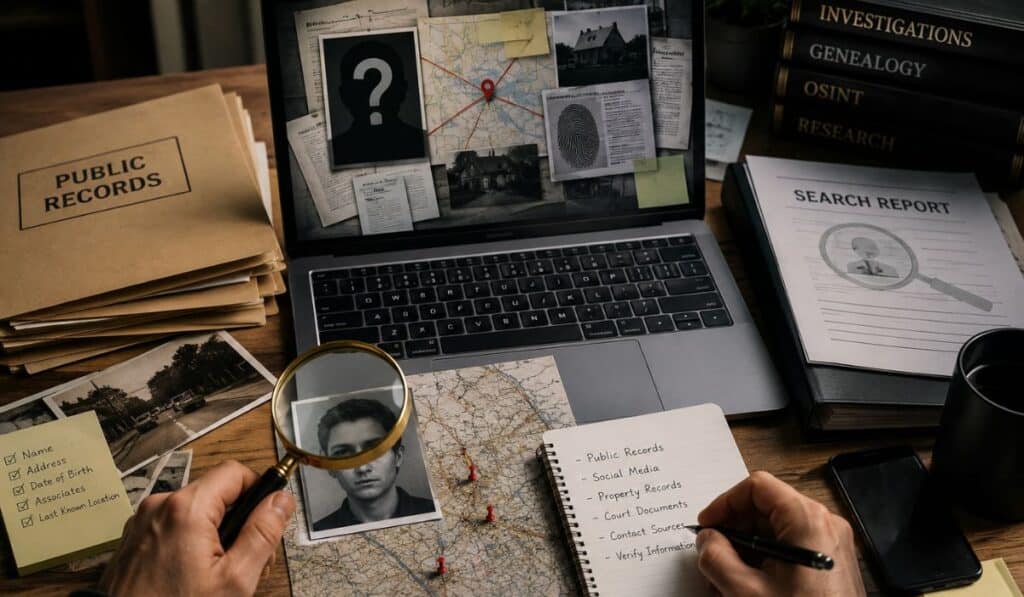
Finding someone may sound like something reserved for private detectives and crime dramas, but in reality, investigators, genealogists, researchers, journalists, and everyday individuals often use structured and legal methods to reconnect with people, verify identities, research family history, or locate missing contacts.
Modern people-finding is rarely about one secret database. Instead, professionals combine multiple sources—including public records, historical archives, digital footprints, open-source intelligence (OSINT), and verification techniques—to build an accurate picture over time.
Whether the goal is genealogy research, reconnecting with relatives, locating heirs, conducting due diligence, or verifying identities, understanding how investigators work can help people search more effectively and responsibly.
This guide explains how investigators find people using legal and ethical methods.
Why Finding People Matters
People searches happen for many legitimate reasons:
- Building family trees and genealogy research
- Reconnecting with relatives or old friends
- Estate and inheritance investigations
- Background verification
- Journalism and historical research
- Legal and civil matters
- Academic and demographic studies
Professional investigators focus less on shortcuts and more on connecting small pieces of public information until patterns emerge.
1. Starting With Public Records
One of the first places investigators begin is public records.
Public records contain government-generated information that may legally be available depending on local laws and regulations.
Examples include:
- Birth records
- Marriage records
- Divorce filings
- Death records
- Voter registration records
- Professional licenses
- Business registrations
- Historical census records
Public records help establish identity, relationships, timelines, and locations.
What Investigators Look For
Investigators usually collect:
- Full legal names
- Previous names
- Approximate age
- Known relatives
- Cities of residence
- Historical addresses
Even incomplete details can become useful when combined.
Example
Someone searching for a grandparent may begin with a marriage record, then connect that information to census data and address history to identify descendants.
2. Searching Address and Property History
Address history often reveals movement patterns over time.
People change jobs, cities, and contact details—but addresses frequently leave records.
Investigators review:
- Property ownership records
- Historical address databases
- Tax assessments
- Rental history where legally available
- Utility-related public records
- Archived directories
Why Address History Matters
Addresses can reveal:
- Household members
- Length of residence
- Geographic migration
- Family relationships
- Associated individuals
Multiple historical addresses may help connect someone whose current contact information is unavailable.
3. Reviewing Court and Government Databases
Court documents can provide valuable public information depending on jurisdiction.
Investigators may review:
- Civil court filings
- Probate records
- Bankruptcy filings
- Business disputes
- Real estate litigation
- Public legal notices
Government databases may also include:
- Business ownership records
- Licensing information
- Corporate registrations
Important Note
Availability varies significantly by country, state, and local privacy laws.
Responsible researchers avoid restricted or confidential records.
4. Using Social Media and Digital Footprints
Social media changed how investigators find people.
Many individuals voluntarily publish location clues, career updates, and connections.
Researchers may review:
- Public profiles
- Employment updates
- Shared locations
- Public comments
- Community memberships
- Archived posts
Patterns Investigators Notice
Instead of focusing on a single profile, they analyze:
- Consistent usernames
- Shared contacts
- Timeline changes
- Geographic overlap
- Public photographs
Real-World Example
A researcher looking for a former classmate may identify a public profile using graduation year, hometown, and mutual connections.
Only publicly visible information should be used.
5. Applying Open-Source Intelligence (OSINT) Methods
Open-source intelligence (OSINT) refers to gathering information from publicly available sources.
OSINT techniques organize scattered information into usable insights.
Common sources include:
- Search engines
- Public archives
- News mentions
- Business directories
- Professional profiles
- Historical web snapshots
- Government publications
Core Principle of OSINT
Verification matters more than speed.
One matching detail rarely confirms identity.
Multiple independent signals create stronger confidence.
6. Exploring Genealogy Records and Family Connections
Genealogy research remains one of the most effective long-term methods for locating individuals.
Family relationships often reveal where people moved and who they remained connected to.
Investigators may use:
- Family trees
- Census records
- Immigration records
- Cemetery records
- Obituaries
- Historical archives
Relationship Mapping
Genealogists often create:
- Parent-child connections
- Sibling networks
- Marriage timelines
- Migration paths
These relationships frequently lead to current relatives.
Example
An obituary may mention surviving family members living in different states, helping researchers continue the search.
7. Reverse Phone and Email Lookups
Contact identifiers can sometimes help establish identity.
Investigators may analyze:
- Historical phone associations
- Public business contact records
- Email mentions
- Public directory listings
Email Research Techniques
Researchers look for:
- Username consistency
- Public profile associations
- Historical mentions
- Published contact details
Important Reminder
A phone number or email alone does not prove identity.
Verification is always required.
8. Interviewing Contacts and Witness Networks
Traditional investigation still matters.
Sometimes the fastest way to find someone is speaking with people who already know them.
Potential information sources include:
- Former neighbors
- Community members
- Historical contacts
- Family connections
- Professional associates
Best Practices
Ethical investigators:
- Identify themselves honestly
- Respect privacy
- Avoid deception
- Accept refusals
The objective is gathering publicly shareable information—not pressuring anyone.
9. Using Skip Tracing Techniques
Skip tracing is the process of locating individuals by connecting publicly available records and behavioral patterns.
This method is commonly used in:
- Legal investigations
- Debt recovery
- Asset research
- Family location services
Skip tracing often combines:
- Address history
- Contact records
- Property information
- Employment indicators
- Relationship mapping
Skip Tracing Is Not Surveillance
Ethical skip tracing focuses on lawful records and verification—not monitoring private activity.
10. Identity Verification and Cross-Matching
Finding a likely match is only the beginning.
Professional investigators spend substantial time confirming identity.
Verification Signals
Researchers compare:
- Full name
- Age range
- Known relatives
- Address overlap
- Employment history
- Geographic consistency
Common Verification Rule
At least three independent matching indicators generally create stronger confidence.
This reduces mistaken identity.
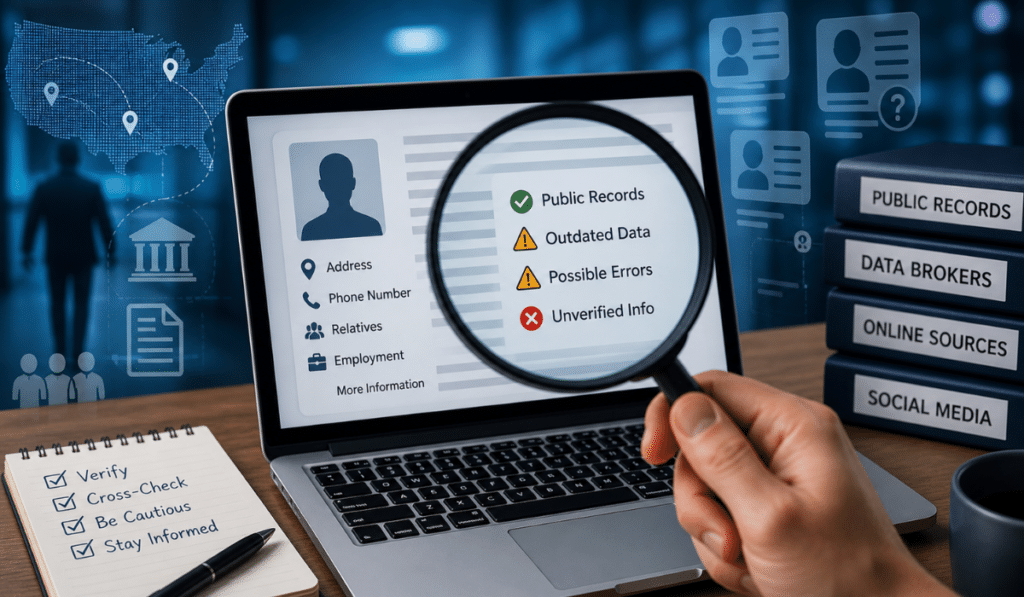
11. Cross-Checking and Validating Information
Experienced investigators trust verification more than volume.
Data can become outdated, duplicated, or inaccurate.
Validation may include:
- Comparing multiple records
- Reviewing historical changes
- Confirming timelines
- Eliminating conflicting information
Questions Investigators Ask
- Does this timeline make sense?
- Are locations consistent?
- Do family relationships match?
- Are there conflicting records?
This final review prevents incorrect conclusions.
Privacy, Ethics, and Legal Considerations
Responsible people searches operate within legal and ethical boundaries.
Good practices include:
- Use only lawful information sources
- Respect privacy expectations
- Avoid impersonation
- Never access restricted accounts
- Follow local regulations
- Verify before making assumptions
Finding information does not automatically mean it should be published or shared.
Common Mistakes When Searching for People
Many searches fail because of avoidable errors.
1. Relying on One Source
No database is complete.
2. Ignoring Historical Records
Older records often reveal key connections.
3. Assuming a Name Match Is Correct
Multiple people may share identical names.
4. Forgetting Relatives
Family links frequently solve difficult searches.
5. Skipping Verification
Cross-checking prevents mistakes.
6. Expecting Immediate Results
People searches often require patience.
Final Thoughts
Understanding how investigators find people reveals an important truth: successful people searches rarely depend on a hidden database or a single breakthrough.
Instead, investigators combine public records search, genealogy research, address history, OSINT techniques, people search records, and identity verification to create a reliable picture.
Whether you want to find people online, reconnect with relatives, research family history, or better understand investigator search techniques, accuracy, patience, and respect for privacy remain the most valuable tools.
The most effective searches are not the fastest—they are the most carefully verified.
Frequently Asked Questions
1. How do investigators find people online?
Investigators combine public records, digital footprints, social media research, genealogy sources, and identity verification techniques.
2. Are public records enough to locate someone?
Usually not. Most successful searches combine multiple independent sources.
3. What is skip tracing?
Skip tracing is a structured process used to locate individuals by connecting legal and publicly accessible information.
4. Can genealogy records help locate living relatives?
Yes. Historical family records often reveal modern family connections.
5. Is OSINT legal?
OSINT uses publicly available information. Laws vary by region, and responsible researchers stay within legal boundaries.
6. Why do investigators verify information multiple times?
Verification reduces mistaken identity and improves accuracy.
7. Can old addresses help find someone?
Yes. Address history often reveals relationships and movement patterns over time.

I am Sandy Saga, the writer and content researcher behind FamilyTreeNow.net. I create clear, easy-to-understand informational content related to family history, people search resources, genealogy topics, and public information awareness. My goal is to help readers understand how online search tools and family research resources work in a simple and responsible way.
The content on FamilyTreeNow.net is published strictly for informational and educational purposes only. I focus on providing accurate, transparent, and reader-friendly information to help users explore and learn. This website does not offer official records, legal advice, or professional services — it exists solely as an independent informational resource.