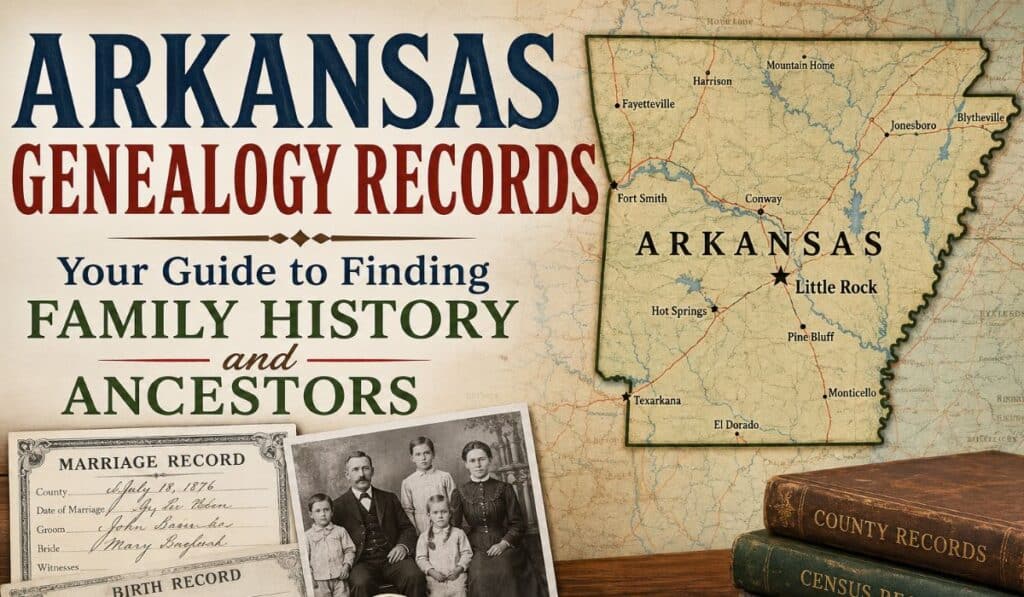
Researching family history in Arkansas is more than collecting names and dates. Every document, census page, land deed, and marriage record tells part of a much larger story—one shaped by migration, settlement, conflict, opportunity, and generations of families creating new lives.
Arkansas genealogy is especially interesting because the state developed through several historical periods that influenced where records were created and how families moved. Native communities lived across these lands for centuries before European arrival. Later came Spanish exploration, French settlements, territorial expansion, military land grants, agricultural growth, and waves of immigration.
If your ancestors lived in Arkansas, understanding this history can make family research easier and more rewarding.
Why Arkansas Is a Valuable State for Genealogy Research
Arkansas developed differently from many eastern states.
Its abundant rivers, fertile lands, timber resources, and mineral wealth attracted settlers across multiple generations. Families moved into Arkansas for farming opportunities, military land grants, trade routes, and economic expansion.
Unlike locations where populations remained stable, Arkansas experienced repeated migration periods.
That movement created a wide variety of records that genealogists can use today.
You may find your family history hidden inside:
- Birth registrations
- Marriage licenses
- Land records
- Military pensions
- Church books
- Probate files
- Census schedules
- Cemetery records
- Local newspapers
The challenge is rarely whether records exist.
The challenge is understanding where and when to search.
Arkansas Before Statehood: Understanding Early Family Movement
Before Arkansas became a state, Native communities had already built long-standing societies throughout the region.
Groups including the Quapaw, Osage, Cherokee, Choctaw, Delaware, Shawnee, and Caddo occupied different parts of the territory across generations.
European exploration began in the sixteenth century.
In 1541, Spanish explorer Hernando de Soto crossed the Mississippi River and entered areas connected to present-day Arkansas. His expedition documented some of the earliest European observations of the region.
More than a century later, French influence became increasingly important.
By 1686, Arkansas Post had become one of the earliest permanent European settlements in the lower Mississippi Valley. It functioned as a trading location and transportation point for travelers moving along the Mississippi River.
Control of the region later shifted between France and Spain.
Eventually, after the Louisiana Purchase in 1803, Arkansas became part of United States territorial expansion.
This matters for genealogy because records may appear under different jurisdictions depending on the year your ancestor lived there.
The Arrival of American Settlers
Many early Arkansas families did not originate in Arkansas.
Large numbers moved west from:
- Kentucky
- Tennessee
- Virginia
- North Carolina
- Georgia
Military service also influenced settlement.
Following conflicts such as the War of 1812 and later the Mexican War, land bounty programs encouraged veterans to relocate into developing territories.
When Arkansas Territory was officially created in 1819, the population remained relatively small compared with eastern states.
But growth accelerated quickly.
New settlements formed.
County governments appeared.
Land ownership expanded.
And record creation increased.
For genealogists, this period often marks the beginning of traceable documentation.
The Most Useful Arkansas Genealogy Records
Census Records: Building the Family Timeline
Census records remain one of the strongest tools in Arkansas genealogy.
A census allows researchers to follow a family across decades and identify changes in household structure.
You may discover:
- Birth years
- Occupations
- Migration patterns
- Property ownership
- Children who disappeared between censuses
- Elderly relatives living with family
Instead of treating each census as isolated information, read them as chapters in one continuous family story.
Birth and Death Records: Establishing Relationships
Birth and death records often become the foundation of research.
A birth record may confirm:
- Parents
- Location
- Exact dates
Death records frequently provide even more information.
Many include:
- Parents’ names
- Burial places
- Informants
- Occupations
One overlooked detail can open an entirely new branch of a family tree.
Marriage Records: Connecting Generations
Marriage records do more than confirm weddings.
They can reveal:
- Previous residences
- Family connections
- Witness relationships
- Age estimates
Many Arkansas researchers solve difficult family mysteries by studying marriage patterns across neighboring counties.
Never search only one county.
Families often crossed county borders for legal or personal reasons.
Land Records: The Hidden Genealogy Resource
Land records receive less attention than census records, but they are often more powerful.
Property transfers can show:
- Parents transferring land to children
- Family proximity
- Economic conditions
- Migration timing
In Arkansas, military land grants and agricultural expansion created extensive land documentation.
If census records seem incomplete, land records often fill the gaps.
Military Records and Their Historical Value
Military records remain essential for Arkansas family history.
Service records may uncover:
- Birth information
- Residence
- Family members
- Pension claims
- Death records
Arkansas played a complex role during the Civil War.
Although the state formally joined the Confederacy, soldiers served on both sides.
This divided history means researchers should examine both Union and Confederate records.
Immigration and Migration Into Arkansas
Many people assume Arkansas genealogy only involves southern families.
In reality, migration patterns changed dramatically over time.
Large settlement periods included:
Early western expansion
Post-Civil War reconstruction
Late nineteenth-century European immigration
Twentieth-century industrial development
Tracking migration helps explain why an ancestor suddenly appears or disappears from records.
Often they did not disappear.
They moved.
Common Mistakes New Genealogy Researchers Make
Searching only online
Not every record has been digitized.
Ignoring county history
County boundaries changed repeatedly.
Accepting family stories as facts
Stories are starting points—not conclusions.
Following one document
Reliable genealogy requires multiple supporting records.
A Simple Method for Researching Arkansas Ancestors
Step 1: Start with yourself.
Step 2: Interview relatives.
Step 3: Collect documents.
Step 4: Build a timeline.
Step 5: Search census records.
Step 6: Add land and military research.
Step 7: Verify everything.
Small verified steps outperform large assumptions.
Final Thoughts
Arkansas genealogy is not simply about locating old documents.
It is about understanding movement—people leaving one place, settling another, building communities, serving in wars, purchasing land, raising families, and leaving traces behind.
Whether your ancestors arrived through early frontier expansion, Native heritage, military settlement, agriculture, or later immigration, Arkansas records offer opportunities to reconnect with those stories.
The best family history research rarely begins with a breakthrough.
It begins with one record—and the decision to keep following the trail.

I am Sandy Saga, the writer and content researcher behind FamilyTreeNow.net. I create clear, easy-to-understand informational content related to family history, people search resources, genealogy topics, and public information awareness. My goal is to help readers understand how online search tools and family research resources work in a simple and responsible way.
The content on FamilyTreeNow.net is published strictly for informational and educational purposes only. I focus on providing accurate, transparent, and reader-friendly information to help users explore and learn. This website does not offer official records, legal advice, or professional services — it exists solely as an independent informational resource.