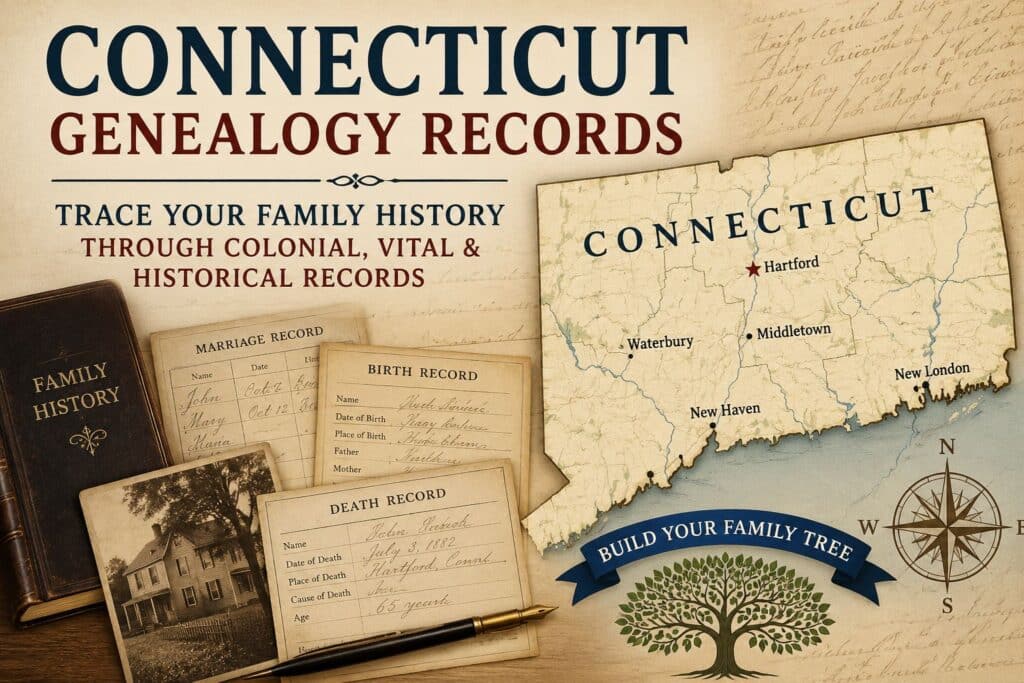
Connecticut genealogy records offer one of the richest sources for tracing American family history. As one of the original 13 colonies and the 5th state to join the United States in 1788, Connecticut preserves centuries of historical records that can help researchers uncover ancestral stories, migration routes, occupations, military service, and family connections.
For genealogists and family historians, Connecticut presents a unique advantage: many communities maintained detailed town records long before statewide systems became common. Whether your ancestors were colonial settlers, industrial workers, immigrants arriving in the 19th century, or families who moved westward, Connecticut family history records can reveal important details about their lives.
Researching Connecticut ancestry records becomes easier when you understand the state’s settlement patterns, record availability, and historical developments that shaped documentation across generations.
Understanding Connecticut’s Historical Background
Connecticut’s history directly influences where genealogical records exist and what information researchers can expect to find.
Long before European settlement, Native American communities lived throughout the region for centuries. Tribes established villages near rivers and fertile land that later attracted colonial settlers.
The first European influence came through Dutch settlement in the early 1600s around present-day Hartford. However, by the 1630s, English settlers moving south from Massachusetts began establishing permanent communities.
Colonial Settlement Timeline
| Year | Historical Event |
|---|---|
| Early 1600s | Native communities occupy region |
| 1614–1630 | Dutch trading activity expands |
| 1636 | English settlers arrive from Massachusetts |
| 1630s | Additional English colonies established |
| 1654 | Dutch settlement abandoned |
| 1776 | American independence |
| 1788 | Connecticut becomes 5th state |
Connecticut River and Early Settlement
The Connecticut River played a major role in early family settlement patterns.
Most colonial families established farms alongside the river because of fertile agricultural land. Towns expanded outward from these farming areas, creating extensive local records.
Land ownership became an important part of family identity, which means property deeds and tax records are valuable resources for genealogy today.
Population Growth and Migration
Following the American Revolutionary War, Connecticut experienced rapid population growth.
Population estimates show:
- 1790: approximately 237,900 residents
- 1830: approximately 297,000 residents
- 1860: approximately 460,000 residents
As the country expanded, many Connecticut families moved north, west, and south searching for farmland and economic opportunities.
Later, industrial growth transformed Hartford, New Haven, and New London into major urban centers.
Understanding these migration patterns helps explain why family records often appear across multiple states.
Types of Connecticut Genealogy Records
Connecticut genealogy records exist across multiple record groups. Successful family history research usually combines several sources rather than relying on a single document.
Birth Records
Connecticut birth records often provide:
- Full name
- Date of birth
- Birthplace
- Parents’ names
- Mother’s maiden name
- Occupation of parents
Early birth documentation was typically maintained at the town level.
Marriage Records
Marriage records can reveal:
- Bride and groom names
- Marriage date
- Residence
- Parent information
- Clergy details
- Witnesses
Marriage documentation often helps connect multiple family generations.
Death Records
Connecticut death records frequently contain:
- Date of death
- Place of death
- Cause of death
- Parents’ names
- Burial information
These records are especially useful for verifying family relationships.
Census Records
Federal census records remain among the strongest genealogy tools.
Useful census years include:
- 1790
- 1800
- 1810
- 1820
- 1830
- 1840
- 1850 onward (expanded household information)
After 1850, records became increasingly detailed.
Church Records
Church documentation may include:
- Baptisms
- Confirmations
- Marriage ceremonies
- Funeral records
- Membership rolls
Church records are especially valuable for colonial research.
Probate Records
Probate records can uncover:
- Family heirs
- Property distribution
- Guardianship records
- Estate inventories
These often identify relationships unavailable elsewhere.
Land Deeds
Land records frequently document:
- Property purchases
- Family transfers
- Boundary changes
- Migration evidence
Military Records
Military collections may include:
- Colonial militia
- Revolutionary War
- War of 1812
- Civil War service
Cemetery Records
Headstones often provide:
- Dates
- Family plots
- Generational relationships
Immigration and Naturalization Records
Useful for tracing foreign-born ancestors.
Newspaper Archives
Historical newspapers can reveal:
- Obituaries
- Community announcements
- Business notices
- Marriage announcements
Town Records
Town records remain one of Connecticut’s most valuable genealogy resources.
Colonial Connecticut Family Research (1636–1776)
Researching colonial Connecticut ancestors requires understanding how records were created.
Unlike later centralized systems, colonial records were maintained locally.
Early Settlers and Community Development
Settlers arriving from Massachusetts established communities based on agriculture, religion, and trade.
Family names often appear repeatedly across church and land records.
Church and Land Records
Church records frequently documented events before government registration became common.
Look for:
- Congregational records
- Baptism registers
- Membership rolls
- Parish documents
Land records help establish residence and movement.
Colonial Documentation Sources
Potential records include:
- Tax lists
- Court proceedings
- Local government records
- Town meeting minutes
- Estate files
Tracking Family Movement
Families often moved between nearby towns.
Follow:
- Land sales
- Marriage records
- Probate transfers
- Census appearance changes
Connecticut Population Growth and Migration
Migration history often explains missing records.
Revolutionary War Population Expansion
Population increased significantly after independence.
Growing agricultural communities encouraged larger settlements.
Westward Movement
Many Connecticut families migrated to:
- New York
- Ohio
- Pennsylvania
- Midwest territories
This movement created family branches across states.
Industrial Transformation
During the early 1800s:
- Manufacturing expanded
- Agriculture declined
- Cities grew rapidly
Families left rural areas for factory employment.
Urban Development
Major urban centers included:
- Hartford
- New Haven
- New London
Urban records often contain more detailed documentation.
Where to Find Connecticut Genealogy Records
Modern researchers have access to both physical and digital archives.
State Archives
Useful collections include:
- Historical manuscripts
- Vital records
- Probate collections
Local Town Clerk Offices
Connecticut towns frequently preserve:
- Birth records
- Marriage certificates
- Land deeds
Historical Societies
Historical organizations may maintain:
- Family files
- Newspapers
- Photographs
Online Genealogy Databases
Digital platforms often provide:
- Census images
- Indexes
- Family trees
- Historical maps
Census Collections
Federal census archives remain foundational.
Search multiple decades to confirm identity.
Researching Immigrant Ancestors in Connecticut
Connecticut’s population became increasingly diverse through immigration.
Italian Communities
Italian families became one of the largest ancestry groups in Connecticut.
Many settled in urban industrial areas.
Irish Migration
Irish immigration expanded during the 1800s.
Church records often become especially useful.
English and German Roots
These communities influenced early industrial and agricultural growth.
Polish-American Communities
New Britain became known for a large Polish-American population.
Immigration and church records can help trace these families.
Modern Immigration Patterns
Recent migration has included populations from:
- Southeast Asia
- Caribbean nations
- Central America
- South America
These newer records may require additional privacy considerations.
Step-by-Step Guide to Building Your Connecticut Family Tree
Building a family tree becomes easier when following a structured approach.
1. Start with Living Relatives
Collect:
- Names
- Dates
- Photos
- Stories
2. Gather Existing Documents
Look for:
- Certificates
- Letters
- Family Bibles
- Military papers
3. Search Historical Records
Begin with:
- Birth records
- Census records
- Marriage records
Expand gradually.
4. Compare Multiple Sources
Never rely on a single document.
Cross-check:
- Dates
- Locations
- Family members
5. Organize Findings
Use:
- Timelines
- Family charts
- Research logs
Common Challenges in Connecticut Genealogy Research
Every genealogy project encounters obstacles.
Missing Records
Solutions:
- Search neighboring towns
- Check church archives
- Use newspaper substitutes
Name Variations
Common issues include:
- Spelling changes
- Nicknames
- Anglicized names
County and Town Confusion
Town-level records are often more important than county records.
Always verify jurisdiction.
Migration Tracking
Use sequential census years and land transactions to confirm movement.
Final Thoughts
Connecticut genealogy records provide an exceptional opportunity to trace family history through nearly four centuries of settlement, migration, and social change.
From colonial farms along the Connecticut River to industrial neighborhoods in growing cities, each generation left records that can help reconstruct family stories.
The most successful Connecticut family tree research combines historical context with multiple record types. Birth records, census collections, church archives, land deeds, and immigration files all contribute pieces of the larger story.
Start with what your family already knows, document carefully, and build backward one generation at a time. Small discoveries often lead to remarkable connections across centuries.
Frequently Asked Questions
1. Are Connecticut genealogy records public?
Many historical records are publicly accessible, though newer records may have restrictions.
2. How far back do Connecticut records go?
Some local records trace back to colonial settlements in the 1600s.
3. Where can I find colonial Connecticut records?
Town offices, church archives, probate collections, and historical archives are strong starting points.
4. Are census records available online?
Many federal census collections are digitized and searchable.
5. What records help identify parents?
Birth, marriage, probate, and death records often provide parental information.
6. How do I trace immigrant ancestors?
Combine census, immigration, naturalization, and church records.
7. What is the most useful record for beginners?
Census records usually provide the easiest starting point.
8. Why do family names change over time?
Spelling standardization developed gradually and immigration affected surnames.
9. Are church records reliable?
Church records are often among the most detailed historical sources.
10. What should I do if records conflict?
Compare multiple documents and prioritize primary sources.

I am Sandy Saga, the writer and content researcher behind FamilyTreeNow.net. I create clear, easy-to-understand informational content related to family history, people search resources, genealogy topics, and public information awareness. My goal is to help readers understand how online search tools and family research resources work in a simple and responsible way.
The content on FamilyTreeNow.net is published strictly for informational and educational purposes only. I focus on providing accurate, transparent, and reader-friendly information to help users explore and learn. This website does not offer official records, legal advice, or professional services — it exists solely as an independent informational resource.