Searching for family history online sounds simple at first. Type a name, click search, and expect instant answers.
Reality works differently.
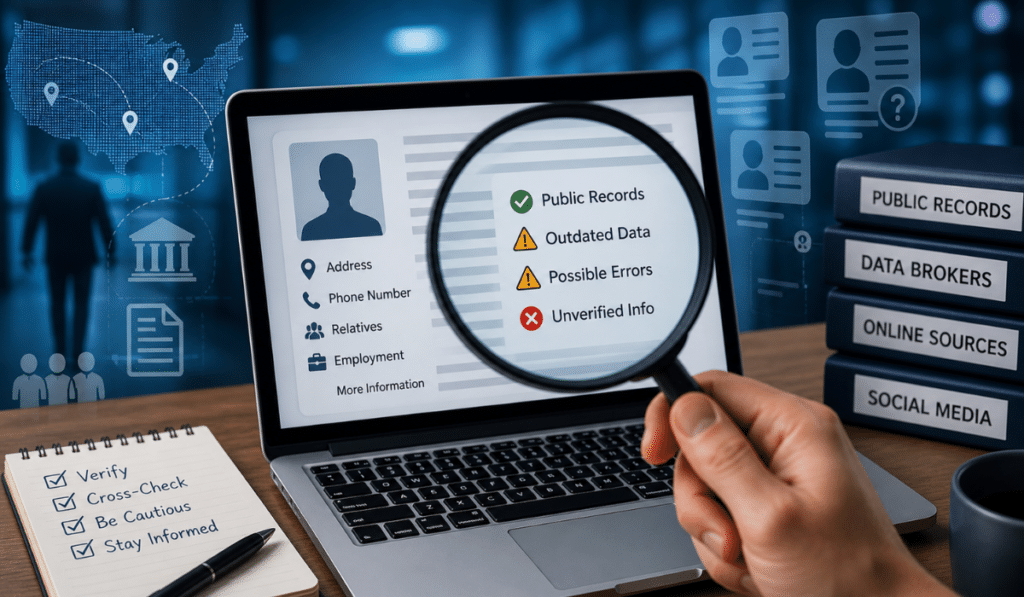
Many users discover that tracing family relationships, locating historical records, or finding publicly available information can quickly become confusing. Results may contain duplicate entries, outdated addresses, missing relatives, or records that appear to belong to entirely different people.
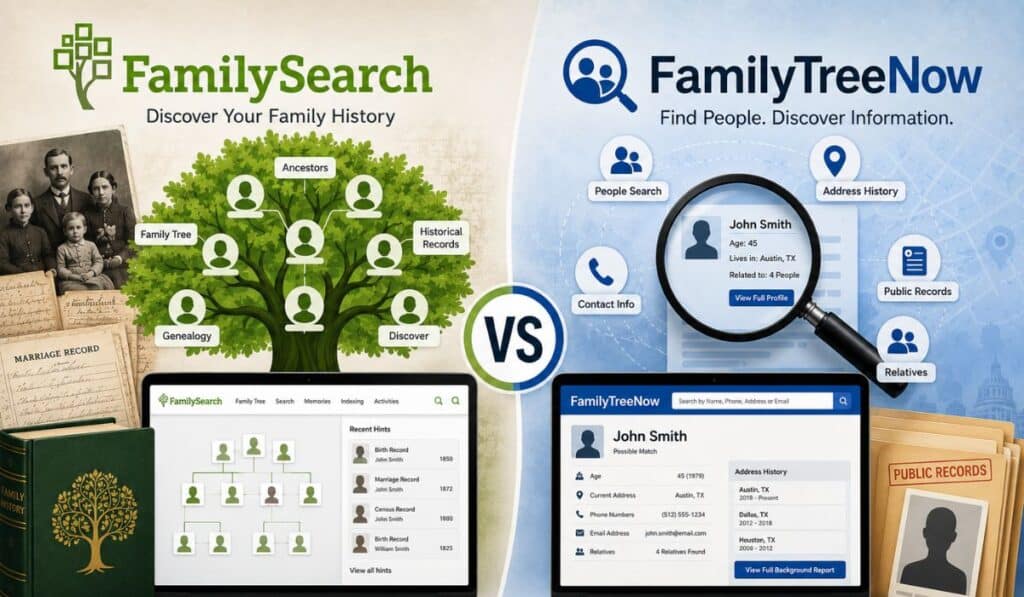
This is exactly why people often compare FamilySearch and FamilyTreeNow.
Although both platforms help users locate information connected to individuals and family relationships, they were built with different purposes in mind.
During our research into public record systems and genealogy databases, one recurring pattern became clear: users frequently assume all people-search tools operate the same way. They do not.
Some systems specialize in historical genealogy records.
Others aggregate publicly available datasets from multiple sources.
Some prioritize family history.
Others prioritize searchable people information.
In this guide, you will learn:
- How FamilySearch and FamilyTreeNow actually work
- Major differences between their databases
- Key features and benefits
- Common mistakes users make
- Data accuracy limitations
- Privacy considerations
- Ethical and legal usage guidance
- Expert insights based on observed industry patterns
FamilySearch:
A genealogy-focused platform designed to help users build family trees and access historical family records.
FamilyTreeNow
A people-search platform that aggregates publicly available information and presents searchable profiles.
While these tools sometimes overlap, their primary goals differ significantly.
| Feature | FamilySearch | FamilyTreeNow | Recommendation |
|---|---|---|---|
| Historical records | Excellent | Limited | FamilySearch |
| Family tree building | Excellent | Basic | FamilySearch |
| People lookup | Moderate | Strong | FamilyTreeNow |
| Address history | Limited | Strong | FamilyTreeNow |
| Public records aggregation | Moderate | Strong | FamilyTreeNow |
| Genealogy research | Excellent | Moderate | FamilySearch |
| Privacy controls | Strong | Requires user awareness | FamilySearch |
Why Trust This Guide
This guide was created using publicly available information, observed industry practices, and analysis of how people-search and genealogy systems generally operate.
We did not rely on marketing claims alone.
During our review process we examined:
- Public record aggregation methods
- Genealogy workflows
- Common user concerns
- Data verification limitations
- Privacy implications
Because records continuously change, users should independently verify information before making personal, legal, or financial decisions.
How People Search Systems Actually Work
One of the most misunderstood concepts in this industry involves how search platforms obtain information.
Users sometimes assume websites manually collect data.
That usually is not how these systems function.
Instead, many systems aggregate information from multiple sources.
Possible data sources include:
- Census records
- Property records
- Court records
- Voter registration information
- Historical archives
- Birth records
- Marriage records
- Death records
- Telephone directories
- Public databases
After analyzing public record databases, one challenge people often face becomes obvious:
Different sources update at different speeds.
As a result:
- Addresses may be outdated
- Names may be duplicated
- Relationships may be inaccurate
- Records may be incomplete
This affects virtually every people search system.
How FamilySearch Works
FamilySearch primarily operates as a genealogy research platform.
Its purpose focuses on helping individuals:
- Discover ancestors
- Build family trees
- Explore historical records
- Collaborate with relatives
Typical workflow:
- Search an ancestor’s name
- Review historical records
- Confirm relationships
- Add verified information
- Expand the family tree
Because genealogy research depends heavily on historical evidence, users often spend time validating multiple sources.
How FamilyTreeNow Works
FamilyTreeNow operates differently.
Instead of emphasizing historical genealogy research, it aggregates publicly available information and organizes it into searchable profiles.
Typical information may include:
- Known addresses
- Possible relatives
- Age ranges
- Public record indicators
Users frequently encounter situations where multiple individuals share similar names.
This can create confusion if records are accepted without verification.
Key Features
FamilySearch Features
- Family tree creation
- Historical document access
- Collaborative editing
- Record hints
- Ancestor discovery tools
- Historical image collections
FamilyTreeNow Features
- Name-based search
- Address history lookup
- Relative associations
- Public record aggregation
- General people search
Benefits
Benefits of FamilySearch
1. Strong genealogy focus
FamilySearch excels at historical family research.
2. Better relationship mapping
Family structures become easier to visualize.
3. Historical depth
Records can span generations.
4. Collaboration
Relatives can contribute information.
Benefits of FamilyTreeNow
1. Quick people lookup
Users can often identify publicly available information rapidly.
2. Easier starting point
Useful when limited information exists.
3. Public information aggregation
Data appears in one location rather than multiple sources.
Pros and Cons
FamilySearch
Pros:
- Excellent genealogy resources
- Strong family tree tools
- Historical record access
- Collaborative features
Cons:
- Learning curve for beginners
- Some records require verification
- Historical research takes time
FamilyTreeNow
Pros:
- Fast searching
- Public record aggregation
- Simple interface
Cons:
- Data may be outdated
- Duplicate profiles possible
- Privacy concerns require attention
Limitations
No platform is perfect.
Based on common patterns observed:
FamilySearch limitations
- Historical gaps may exist
- Some regions have limited records
- User-generated edits can create inconsistencies
FamilyTreeNow limitations
- Public records change frequently
- Data aggregation errors occur
- Relationship assumptions may be incorrect
Common Mistakes Users Make
1. Assuming every result is correct
Public records are not automatically accurate.
2. Ignoring duplicate names
Common names often create confusion.
3. Skipping source verification
Users should compare multiple records.
4. Treating people search as legal evidence
Information should not replace verified documentation.
5. Confusing genealogy with people lookup
These serve different goals.
Expert Insights
During our research, several recurring patterns appeared.
Pattern 1: Most users begin with insufficient information
People often start with:
- First name
- Approximate age
- City
This increases ambiguity.
Pattern 2: Historical verification matters
Experienced researchers rarely rely on one source.
Instead they compare:
- Census records
- Marriage records
- Death records
- Newspaper archives
Pattern 3: Context matters more than names
Names alone create weak search signals.
Additional details improve accuracy:
- Birth year
- Locations
- Family relationships
Privacy Concerns and Ethical Usage
Privacy discussions frequently emerge around people-search tools.
Users should understand:
Publicly available does not mean consequence-free
Information may technically be public while still raising privacy concerns.
Consider:
- Personal safety
- Sensitive relationships
- Outdated information
Ethical usage includes:
- Respecting privacy
- Avoiding harassment
- Avoiding misuse
- Following applicable laws
Legal Considerations
People-search information should not automatically be used for:
- Employment decisions
- Tenant screening
- Financial decisions
- Legal investigations
Users should follow applicable regulations and verify information independently.
Final Conclusion: FamilySearch vs FamilyTreeNow Comparison
The FamilySearch vs FamilyTreeNow Comparison ultimately comes down to purpose.
Users researching ancestors and historical family relationships typically benefit more from FamilySearch.
Users seeking broader people-search functionality and publicly available information may find FamilyTreeNow useful.
The important takeaway is that neither platform guarantees perfect information.
Public record systems have limitations.
Historical records contain gaps.
Search algorithms make assumptions.
The most effective approach combines multiple sources, independent verification, and careful interpretation rather than relying on a single result.
Frequently Asked Questions
1. Is FamilySearch free?
FamilySearch provides many genealogy resources without cost.
2. Is FamilyTreeNow free?
Many searches may be accessible without payment.
3. Which is better for ancestry research?
FamilySearch generally performs better for ancestry-focused research.
4. Which is better for finding living relatives?
FamilyTreeNow may provide more people-search functionality.
5. Are records always accurate?
No. Public records frequently contain inaccuracies.
6. Why do duplicate profiles appear?
Information may originate from multiple databases.
7. Can information become outdated?
Yes. Updates occur at different times.
8. Is genealogy research the same as people search?
No. Genealogy focuses on family history while people search emphasizes identifying individuals.
9. Should I verify records?
Yes. Cross-check multiple sources whenever possible.
10. Can these platforms replace official documentation?
No. Official records remain important.

I am Sandy Saga, the writer and content researcher behind FamilyTreeNow.net. I create clear, easy-to-understand informational content related to family history, people search resources, genealogy topics, and public information awareness. My goal is to help readers understand how online search tools and family research resources work in a simple and responsible way.
The content on FamilyTreeNow.net is published strictly for informational and educational purposes only. I focus on providing accurate, transparent, and reader-friendly information to help users explore and learn. This website does not offer official records, legal advice, or professional services — it exists solely as an independent informational resource.