Tracing family history is no longer limited to dusty archives and handwritten family trees. Today, one of the most powerful — and often overlooked — genealogical clues is something simple: an address.
An old home address can unlock multi-generational households, reveal hidden relatives, expose migration patterns, and connect you to records you never knew existed. If you want to find relatives by address, perform an address history lookup, or trace family members online, this step-by-step guide will show you exactly how to do it — responsibly and effectively.
Why Addresses Are Powerful Genealogical Clues
An address is more than a location. It is a data anchor — a fixed point in time that ties people together.
When you analyze historical addresses, you can:
- Identify family members living in the same household
- Discover maiden names and married names
- Track inheritance transfers
- Reveal extended family living nearby
- Reconstruct multi-generational households
- Understand migration patterns
Unlike names (which change) or occupations (which vary), an address often remains stable long enough to connect multiple records across years.
The Core Principle
If two individuals share the same residential address during the same period, there is a high probability of a relationship — familial, marital, or economic.
That single insight forms the foundation of address-based genealogy research.
Step 1: Start With a Known Address
Begin with:
- A childhood home
- A grandparent’s property
- An address listed on a birth certificate
- An old envelope or family document
- A remembered street from family stories
Even partial information (street name + city) can be useful.
From there, conduct an address history lookup to determine:
- Who lived there
- During which years
- Whether multiple households were registered
- If ownership changed hands within the same surname
Step 2: How Historical Addresses Reveal Family Relationships
Historical address research works because of household clustering.
1. Multi-Generational Households
Before the 1960s, it was common for:
- Parents
- Married children
- Grandchildren
- In-laws
to live in the same home.
If you discover five individuals listed at one address across records, this often indicates:
- Parent + adult child family structure
- Recently married couple living with parents
- Widow living with son or daughter
2. Surname Variations at the Same Address
Example:
- Robert Thompson
- Mary Thompson
- Susan Clark (same address)
Susan Clark may be:
- A married daughter
- A widowed sister
- A niece
Cross-referencing dates and ages helps confirm relationships.
Step 3: Using Property Records to Trace Lineage
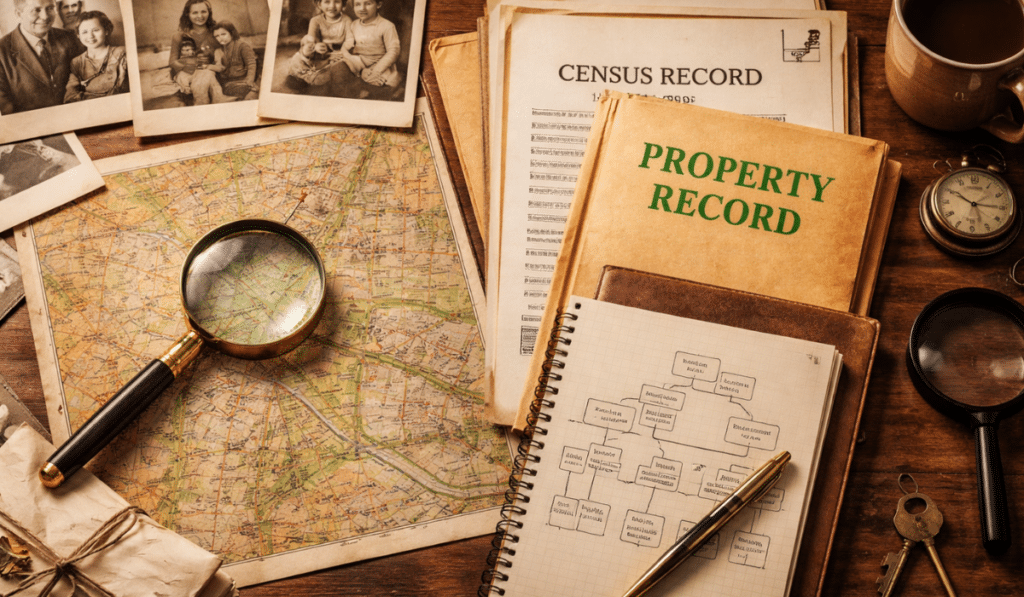
Property records are goldmines in genealogy.
They reveal:
- Deeds
- Title transfers
- Co-owners
- Inheritance transfers
- Trust ownership
- Estate settlements
How Property Transfers Reveal Family Links
If property transfers from:
- John Miller → David Miller (no sale recorded)
This often indicates:
- Father to son inheritance
- Family trust transfer
- Estate distribution
Look for:
- Same surname transfers
- $1 or nominal consideration sales
- Transfers upon death
These patterns strongly suggest familial relationships.
Step 4: Using Census Data to Confirm Household Members
Census records are one of the most reliable ways to trace family members online.
They show:
- Full names
- Ages
- Relationship to head of household
- Occupation
- Birthplace
By matching an address from property or directory records with census listings, you can:
- Confirm parent-child relationships
- Identify spouses
- Detect stepchildren
- Identify boarders who may be relatives
Pro Tip
If a census lists someone as “boarder” but shares the same surname, investigate further — they may be extended kin.
Step 5: City Directories and Address Tracking
Before the digital era, city directories functioned like annual resident databases.
They include:
- Resident names
- Occupations
- Employer
- Residential address
- Spouse name (often listed in parentheses)
Example entry:
Smith, John (Mary), carpenter, h 214 Elm St
This reveals:
- Spouse name
- Occupation
- Exact address
- Year of residence
By tracking the same address across multiple years, you can identify:
- When someone moved in
- When someone moved out
- When a spouse passed away
- When adult children began appearing at the same residence
Read Also: How to Verify or Confirm Possible Relatives Found in People Search Results
Step 6: Using Neighbors to Identify Extended Family (Cluster Research)
This is one of the most powerful techniques in genealogy: cluster research, also known as the FAN Method (Friends, Associates, Neighbors).
Families often lived near:
- Siblings
- Cousins
- In-laws
- Business partners
Why Neighbors Matter
If:
- John Harris lives at 120 Oak St
- William Harris lives at 124 Oak St
- Sarah Miller (maiden name Harris) lives at 118 Oak St
You may have uncovered sibling connections.
When tracing family members online, always map nearby households within:
- 2–5 houses
- Same street
- Adjacent properties
- Same census page
Patterns frequently reveal kinship networks.
Step 7: Tracking Migration Through Address Changes
Address changes tell stories.
If a family moves from:
- Rural Ohio (1905)
- To Chicago (1915)
- To Detroit (1925)
You may be observing:
- Industrial migration
- Economic shifts
- War-time employment
- Family expansion
By mapping address changes over decades, you can reconstruct family timelines.
Read Also: How Address History Helps Identify Household Members
Practical Case Study: Tracing a Hidden Uncle Through Address Records
Let’s walk through an example.
Step 1: Starting Clue
Grandmother’s old address:
245 Maple Street, Dayton, Ohio (1948)
Step 2: Address History Lookup
Records show:
- Margaret Wilson (1945–1962)
- Thomas Wilson (1945–1955)
- Daniel Wilson (1952–1955)
Step 3: Census Cross-Reference
Census reveals:
- Thomas Wilson (Head)
- Margaret Wilson (Wife)
- Daniel Wilson (Son)
But an earlier record from 1940 shows:
- Thomas Wilson
- Margaret Wilson
- Edward Wilson (age 12)
Edward disappears in later records.
Step 4: City Directory Review
1947 directory shows:
Edward Wilson, mechanic, 312 Pine St
Same surname. Same city.
Cross-check reveals Edward is Thomas’s brother — living nearby.
This method uncovered an extended branch of the family that was previously unknown.
Read Also: How to Identify Relatives with Similar Names (Without Making Mistakes)
Read Also: 7 Proven Methods to Locate Missing Family Members
Common Mistakes in Address-Based Genealogy Research
1. Assuming Same Surname = Family
Common surnames (Smith, Johnson, Brown) require additional evidence.
2. Ignoring Time Overlaps
Two people at the same address 30 years apart are not automatically related.
3. Not Accounting for Renumbered Streets
Cities frequently renumber streets. Always verify historical maps.
4. Confusing Rental Tenants With Family
Boarders and renters may not be related.
5. Overlooking Women’s Name Changes
Married daughters may appear under different surnames at the same address.
Ethical and Privacy Considerations
When conducting address-based research:
- Respect living individuals’ privacy
- Do not publish sensitive personal details
- Follow public record usage laws
- Avoid harassment or misuse
Responsible genealogy focuses on historical and publicly available information.
If you use online databases to trace family members online, ensure compliance with privacy standards and terms of use.
Advanced Techniques for Address-Based Genealogy
1. Map Overlay Analysis
Use historical maps to compare:
- Old street layouts
- Property boundaries
- Neighborhood clustering
2. Probate Records
Wills often list:
- Property addresses
- Heirs
- Distribution of assets
3. Tax Assessment Records
These show:
- Property value changes
- Ownership continuity
- Transfer timing
Step-by-Step Summary Checklist
- Start with a known address
- Perform an address history lookup
- Identify all residents at that address
- Cross-reference census records
- Check property deed transfers
- Review city directories
- Map nearby households
- Track migration patterns
- Verify relationships with multiple sources
- Document findings systematically
Conclusion – Turning an Address Into a Family Tree
An address is not just a location — it is a genealogical fingerprint.
By combining:
- Property records
- Census data
- City directories
- Neighbor clustering
- Migration tracking
you can uncover family relationships that traditional name searches might miss.
If you want to find relatives by address, perform an accurate address history lookup, or trace family members online, follow the structured process outlined in this guide.
Family history research rewards patience and verification. One old address — written on a faded envelope — may be the key to unlocking generations of hidden connections.
Frequently Asked Questions (FAQ)
Can I find relatives by address alone?
An address alone rarely proves a relationship, but it provides a powerful starting point. When combined with census, property, and directory records, it can strongly indicate familial ties.
How accurate is address history lookup?
Accuracy depends on source reliability and historical record completeness. Always verify across multiple data sources.
Is it legal to trace family members online?
Using publicly available records for genealogical research is legal in most jurisdictions. However, misuse of personal data may violate privacy laws.
What if the address no longer exists?
Check:
- Historical maps
- Property parcel records
- City renumbering archives
Addresses sometimes change, but land parcels often remain traceable.
How do I confirm if neighbors were relatives?
Look for:
- Shared surnames
- Marriage records
- Probate connections
- Census relationship indicators

I am Sandy Saga, the writer and content researcher behind FamilyTreeNow.net. I create clear, easy-to-understand informational content related to family history, people search resources, genealogy topics, and public information awareness. My goal is to help readers understand how online search tools and family research resources work in a simple and responsible way.
The content on FamilyTreeNow.net is published strictly for informational and educational purposes only. I focus on providing accurate, transparent, and reader-friendly information to help users explore and learn. This website does not offer official records, legal advice, or professional services — it exists solely as an independent informational resource.