When most people hear the term “public records,” they imagine dusty files locked away in government offices. The truth is far more interesting. Public records are living documents that quietly record the milestones of everyday life—births, marriages, homes, court decisions, and even where people voted. Together, they form one of the most powerful tools for tracing family history.
If you are beginning your genealogy journey, understanding public records is essential. These records are the foundation of reliable family research. They provide context, verification, and continuity across generations. More importantly, they help separate family myths from documented facts.
This guide explains what public records are, the different types available, how they are created and updated, how accurate and legally accessible they are in the United States, and the ethical considerations every researcher should keep in mind. By the end, you will understand not only how public records work, but why they matter.
What are public records?
Public records are documents created or maintained by government agencies in the course of their official duties. Because they are produced using public resources, many of these records are legally accessible to the public.
Public records exist at multiple levels:
- Federal
- State
- County
- City or municipal
Each level records different types of information. Together, they provide a structured, chronological account of individuals, families, and communities.
For genealogy and family history research, public records act as independent evidence. Unlike personal memories or oral histories, public records were created at the time an event occurred or shortly afterward, making them especially valuable for accuracy.
Why public records are essential for family history research
Family stories are meaningful, but they are often incomplete or altered over time. Public records help ground those stories in verifiable facts.
They allow you to:
- Confirm names, dates, and relationships
- Trace where families lived over time
- Understand social and economic conditions
- Identify relatives you may not know existed
- Resolve conflicting information
In many cases, public records are the only surviving proof that a person lived, worked, or owned property in a specific place.
Types of public records used in genealogy
Public records come in many forms. Each type provides a different piece of the family history puzzle. Understanding how they work helps you know where to look and what to expect.
Census records
Census records are among the most valuable resources for genealogists.
What census records contain
Census data typically includes:
- Names of household members
- Age or birth year
- Relationship to the head of household
- Place of birth
- Occupation
- Immigration or citizenship status
In the United States, federal census records are taken every ten years. Older census records are usually made public after a privacy period.
Why census records matter
Census records show families as they lived together at a specific moment in time. They help you:
- Identify children who may not appear in other records
- Track family movement across states or cities
- Confirm relationships and timelines
Because census records span decades, they allow you to watch families grow, separate, relocate, and change occupations.
Vital records (birth, marriage, and death)
Vital records document the most significant life events. They form the backbone of genealogical research.
Birth records
Birth records usually list:
- Full name
- Date and place of birth
- Parents’ names
- Sometimes parents’ ages or birthplaces
These records establish biological relationships and generational links.
Marriage records
Marriage records often include:
- Names of both spouses
- Date and place of marriage
- Ages or birth dates
- Witnesses’ names
Marriage documents are especially important for tracing women’s maiden names and connecting family lines.
Death records
Death records may contain:
- Date and place of death
- Age at death
- Cause of death
- Marital status
- Next of kin
Death records often confirm relationships that are not documented elsewhere.
Property and land records
Property records are frequently overlooked, but they are incredibly valuable for family history research.
What property records show
Property and land records may reveal:
- Ownership history
- Purchase and sale dates
- Family inheritance patterns
- Exact locations of ancestral homes
In earlier generations, land was often passed down within families, making property records useful for identifying relationships.
Why property records matter
Land records help explain:
- Why families moved or stayed
- Economic status over time
- Connections between neighboring families
They also provide geographic anchors that help tie other records together.
Court and legal records
Court records capture moments of conflict, resolution, and transition.
Types of court records
These may include:
- Probate records
- Wills and estate settlements
- Divorce filings
- Guardianship cases
- Civil lawsuits
Genealogical value of court records
Court documents often list family relationships in detail, especially in probate and inheritance cases. A single will can identify multiple generations at once.
These records also humanize ancestors by revealing challenges they faced, such as debt disputes, property conflicts, or family disagreements.
Voter registration records
Voter records document civic participation and residency.
What voter records can show
Depending on time period and location, voter records may include:
- Full name
- Address
- Date of registration
- Political district
How voter records help genealogy
Voter records are useful for confirming where a person lived during non-census years. They help fill gaps between major record collections.
How public records are created
Understanding how records are created helps explain why errors exist and how to interpret them correctly.
Who creates public records
Public records are created by:
- Government clerks
- Hospital administrators
- Census enumerators
- Court officials
- County recorders
These individuals recorded information provided by citizens, families, or legal representatives.
When records are created
Some records are created immediately, while others are recorded later:
- Birth certificates may be filed days or weeks after birth
- Death certificates are often completed by multiple parties
- Census records rely on self-reported information
Delays and secondhand reporting can introduce inaccuracies.
How public records are updated and corrected
Public records are not static. Corrections and updates happen, though the process varies by record type and jurisdiction.
Corrections to records
Errors may be corrected due to:
- Misspellings
- Incorrect dates
- Legal name changes
- Adoption or legitimation
However, older records may remain unchanged, even if errors are known. Instead, amendments or annotations may be added.
Why inconsistencies exist
Common reasons include:
- Illiteracy or language barriers
- Accents and phonetic spelling
- Intentional age changes for employment or marriage
- Misunderstandings during data collection
For genealogists, this means flexibility and cross-verification are essential.
Accuracy of public records in the United States
Public records are generally reliable, but they are not perfect.
Strengths of public records
- Created close to the event
- Often legally required
- Maintained by official institutions
Limitations of public records
- Human error
- Missing or destroyed records
- Inconsistent formats across states
- Limited detail in early records
Accuracy improves when multiple record types support the same conclusion.
Legal availability of public records in the U.S.
The United States operates under a principle of public access, but privacy laws apply.
Records commonly available to the public
- Census records (after release period)
- Property records
- Court records
- Historical vital records
Records with restricted access
- Recent birth certificates
- Certain adoption records
- Some juvenile court records
Access rules vary by state, making local research knowledge important.
Ethical considerations when using public records
Just because a record is legally accessible does not mean it should be used without thought.
Respect for living individuals
Genealogists should avoid:
- Publishing sensitive information about living people
- Sharing addresses or contact details without consent
- Misusing records for harassment or harm
Responsible research practices
Ethical family research involves:
- Using information for historical or personal understanding
- Respecting privacy boundaries
- Acknowledging uncertainty where it exists
Trust is built when research is handled responsibly.
How public records support people-search and genealogy tools
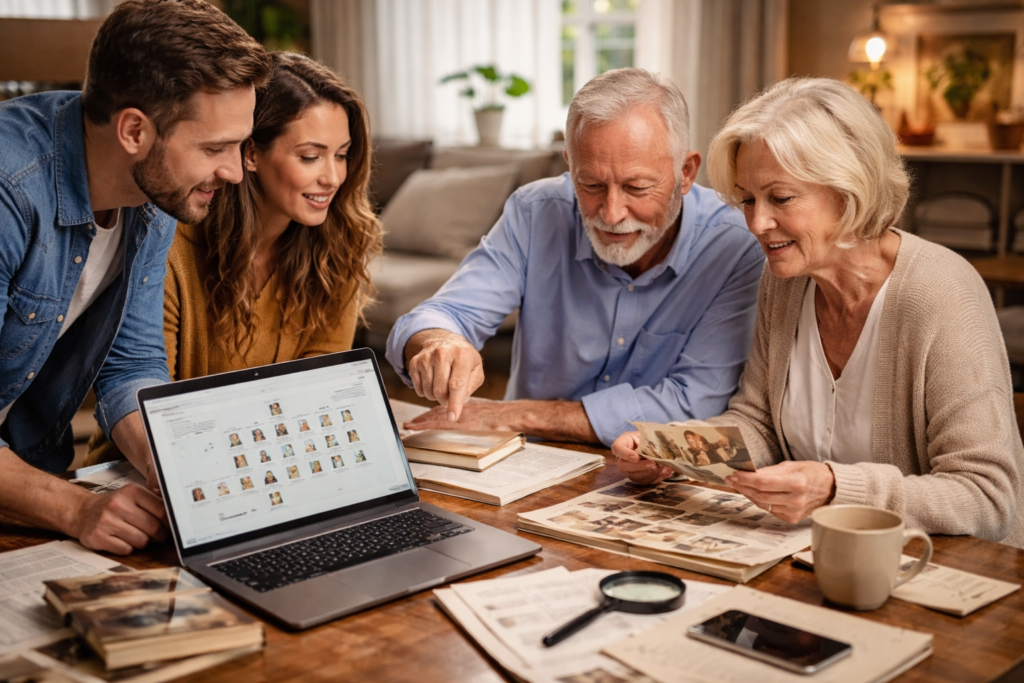
Modern genealogy platforms rely heavily on public records. These tools organize, index, and cross-reference vast collections that would otherwise be difficult to navigate.
Public records provide the raw data. Search tools provide structure, speed, and accessibility. Understanding the source of the data helps users interpret results correctly rather than assuming every result is definitive.
Common misconceptions about public records
“Public records are always accurate”
They are reliable, but not infallible. Verification is essential.
“If it’s online, it must be complete”
Many records are still offline or partially digitized.
“Public records violate privacy”
Public records follow legal frameworks designed to balance transparency and privacy.
Best practices for using public records in family research
- Start with what you know
- Work backward methodically
- Cross-check multiple record types
- Keep detailed notes
- Be patient with dead ends
Genealogy is a process of reasoning, not just searching.
A final reflective thought
Public records remind us that every life leaves a trace, even if it is just a name on a form or an address in a ledger. When you follow those traces, you begin to see how resilience is passed down quietly through generations. Families adapt, endure, and move forward, often without realizing the strength they are building for the future. In learning where you come from, you gain a deeper appreciation for growth, not as a single moment, but as a continuous story shaped by time, choice, and perseverance.
Frequently Asked Questions (FAQs)
Are public records free to access?
Many public records are free, though some jurisdictions charge small fees for copies or certified documents.
Can public records help me find living relatives?
They can provide clues, but ethical considerations and privacy laws apply when researching living individuals.
Why do names appear differently across records?
Spelling variations, transcription errors, and language differences are common in historical records.
Are online public record databases reliable?
They are useful tools, but original records should be reviewed whenever possible.
What should I do if records conflict?
Compare sources, consider context, and document uncertainties rather than guessing.

I am Sandy Saga, the writer and content researcher behind FamilyTreeNow.net. I create clear, easy-to-understand informational content related to family history, people search resources, genealogy topics, and public information awareness. My goal is to help readers understand how online search tools and family research resources work in a simple and responsible way.
The content on FamilyTreeNow.net is published strictly for informational and educational purposes only. I focus on providing accurate, transparent, and reader-friendly information to help users explore and learn. This website does not offer official records, legal advice, or professional services — it exists solely as an independent informational resource.