
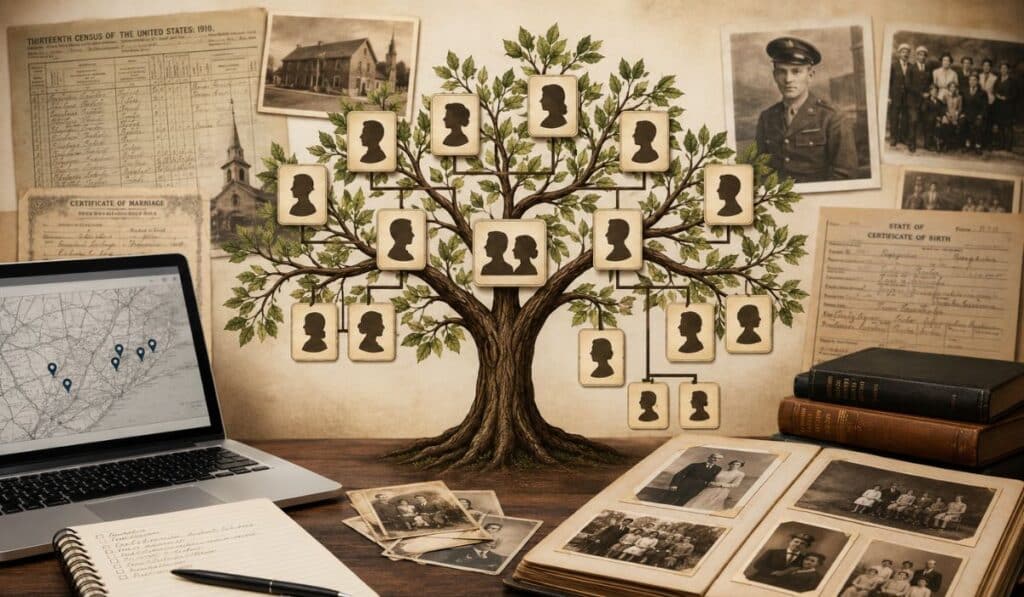
Building a family tree sounds simple at first. Many people assume they only need a few names and dates before a complete family history begins taking shape.
Then reality appears.
You remember your grandparents’ names but not their birth years. One relative spells a surname differently. Old family stories start conflicting with one another. Suddenly a project that seemed straightforward becomes confusing.
Users frequently encounter this exact situation when they begin family history research.
Many also assume they need expensive genealogy subscriptions before they can uncover meaningful information. That belief often stops people before they even begin.
The good news is that you can build a family tree without paying money.
During our research into genealogy resources and public record systems, we found that a significant amount of family information already exists through publicly available sources. Birth records, census data, newspaper archives, historical documents, and family records can provide valuable pieces of a much larger picture.
The challenge is not always finding information.
The challenge is knowing where to look, understanding what data means, and separating verified facts from assumptions.
In this guide, you’ll learn:
• How family tree research actually works
• Free ways to collect family information
• How people search systems organize records
• Common mistakes researchers make
• Privacy and ethical considerations
• Practical methods to improve accuracy
• Expert recommendations for long-term success
Whether you’re tracing your roots out of curiosity, preserving family history for future generations, reconnecting with relatives, or researching ancestry, this guide will help you build a family tree step by step without paying money.
What Does it Mean to Build a Family Tree?
A family tree is a structured representation of family relationships that organizes ancestors, descendants, and relatives across generations. It combines personal information, historical records, and documented relationships into one organized structure.
A family tree typically includes:
• Full names
• Birth dates
• Death dates
• Marriage information
• Locations
• Parent-child relationships
• Supporting records and documents
Some family trees remain small and focus only on immediate relatives.
Others grow into multi-generational projects involving hundreds or thousands of individuals.
The size matters less than accuracy.
Based on common patterns observed in family research communities, successful family trees usually begin with reliable information from living relatives rather than broad online searching.
How Family Tree Research Actually Works
People often imagine genealogy as searching one large database containing every person who has ever lived.
That is not how it works.
Family history research is more like assembling a puzzle from many independent sources.
Information can come from:
| Source Type | Information Found | Reliability |
|---|---|---|
| Family interviews | Names, stories, relationships | Moderate |
| Birth records | Birth details | High |
| Marriage records | Spouse information | High |
| Census records | Household information | Moderate–High |
| Newspaper archives | Events and announcements | Moderate |
| Military records | Service history | High |
| Obituaries | Family connections | Moderate |
| Public records databases | Various details | Varies |
No single source usually tells the entire story.
Instead, researchers compare multiple sources to confirm relationships.
For example:
You discover a census record showing “John Smith” living with “Sarah Smith.”
That does not automatically prove Sarah is John’s daughter.
You might need:
• Birth records
• Marriage records
• Additional census data
• Obituaries
• Family interviews
Multiple data points create stronger confidence.
How People Search Systems Organize Information
Understanding this process helps many beginners avoid confusion.
People search systems generally do not create original family information.
Instead, they aggregate data from various sources.
After analyzing public record databases and industry patterns, these systems often collect information from:
• Public records
• Address history databases
• Telephone directories
• Property records
• Court records
• Historical records
• Government databases
• User-contributed information
The system then attempts to match identities and relationships.
However, matching systems are imperfect.
Two individuals with identical names may accidentally become associated with one profile.
Nickname variations can create duplicate identities.
Marriage-related surname changes may create confusion.
This explains why users sometimes discover incorrect relatives or missing information.
One challenge people often face is assuming every online relationship result is automatically accurate.
That assumption can create long chains of mistakes inside family trees.
Key Features of Building a Family Tree Without Paying Money
Building a family tree for free does not necessarily mean sacrificing quality.
Free research approaches can still provide substantial value.
Key features include:
1. Access to publicly available records
Many historical records are accessible without payment.
Examples include:
• Census archives
• Military collections
• Government records
• Historical newspapers
• Cemetery information
2. Family collaboration
Relatives frequently possess information unavailable online.
Examples include:
• Photographs
• Letters
• Certificates
• Oral stories
• Family documents
3. Incremental growth
Good family trees grow gradually.
Experienced researchers rarely attempt building ten generations immediately.
Instead they build:
Immediate family → grandparents → great-grandparents → extended branches
Benefits of Building a Family Tree
Building a family tree offers benefits beyond curiosity.
Personal identity
Many people want a better understanding of where they came from.
Family history can provide context around:
• Cultural background
• Migration patterns
• Family traditions
• Historical experiences
Historical preservation
Stories disappear quickly when they are not documented.
A family tree can preserve information for future generations.
Relative discovery
Some users reconnect with distant relatives through research.
Medical awareness
Family history occasionally reveals hereditary patterns that may be useful in medical discussions.
Educational value
Children often gain a stronger understanding of history when learning how family experiences connect to larger events.
Pros and Cons
| Pros | Cons |
|---|---|
| No subscription cost | Research can take time |
| Access to public information | Some records are incomplete |
| Can preserve family history | Data may contain inaccuracies |
| Encourages collaboration | Privacy concerns may arise |
| Flexible process | Verification is necessary |
Why Trust This Guide
FamilyTreeNow aims to help users understand people search and public record information through transparent educational content.
This guide was developed using:
• Publicly available information
• Public record research practices
• Industry methodology analysis
• Data transparency principles
We recognize that family research contains verification challenges, and information should always be confirmed through multiple independent sources.
How Information Was Reviewed
Information included in this guide was reviewed based on:
• Publicly accessible records and sources
• Established genealogy practices
• Cross-source comparison methods
• Data accuracy limitations
Because public records change over time, users should independently verify information before making decisions based on family history findings.
Limitations of Building a Family Tree for Free
Free family tree research can be powerful, but users should understand where limitations appear.
One of the biggest misconceptions is assuming that “free” automatically means “complete.”
It does not.
Even experienced researchers regularly encounter missing records, conflicting information, and incomplete historical data.
During our research into public record systems and genealogy workflows, several recurring limitations emerged.
1. Not every record is digitized
Large portions of historical information still exist in:
• Physical archives
• Local government offices
• Churches
• Libraries
• Historical societies
• County records
Many records have never been scanned into online systems.
For example:
A marriage certificate from the 1940s may exist in a county archive but not appear in online databases.
Users sometimes interpret missing online information as evidence that records do not exist.
That assumption is often incorrect.
2. Data inconsistencies happen frequently
Names change over time.
Spelling variations create confusion.
Dates are sometimes entered incorrectly.
Examples:
| Original Name | Alternate Version |
|---|---|
| Katherine | Catherine |
| Elizabeth | Liz |
| William | Bill |
| Jonathon | Jonathan |
Historical records also frequently contain transcription errors.
A handwritten “Smith” may become “Smyth.”
A birth year may be off by several years.
Based on common patterns observed in family research communities, small errors often create major confusion across multiple generations.
3. Family stories are not always factual
Family memories provide valuable context.
But memories can become distorted over time.
Examples include:
• Incorrect immigration stories
• Misremembered dates
• Missing family relationships
• Simplified family histories
Family stories should be treated as research clues rather than final evidence.
4. Privacy restrictions limit access
Certain information remains restricted.
Examples may include:
• Recent birth records
• Adoption records
• Juvenile information
• Certain court documents
Privacy laws vary by location.
Common Mistakes People Make When Building a Family Tree
One challenge people often face is moving too quickly.
The excitement of discovering new relatives sometimes leads users to make assumptions before confirming information.
Here are the most common mistakes observed during family research.
Mistake 1: Starting too far back
People often begin with great-great-grandparents they know very little about.
A better process:
- Start with yourself
- Add parents
- Add grandparents
- Expand outward gradually
Building from verified information creates a stronger foundation.
Mistake 2: Trusting one source completely
No single source should be treated as absolute proof.
Instead compare:
• Birth records
• Census data
• Obituaries
• Family interviews
• Historical documents
Multiple independent sources improve confidence.
Mistake 3: Ignoring surname variations
Historical records contain many spelling inconsistencies.
For example:
MacDonald
McDonald
Mc Donnell
Searching only one spelling may hide valuable information.
Mistake 4: Copying other family trees without verification
Users frequently copy online family trees directly into their own projects.
This creates a common problem:
Errors spread quickly.
If one person incorrectly identifies an ancestor, dozens of additional trees may repeat that mistake.
Mistake 5: Failing to document sources
Months later, many users forget where information originally came from.
Record:
• Source name
• Date accessed
• Record type
• Notes
This makes future verification much easier.
Expert Insights: Strategies That Improve Results
After analyzing public record databases and family research methods, several practical approaches consistently improve outcomes.
Expert Tip #1: Use the “cluster method”
Instead of researching one individual alone, research connected people:
• Siblings
• Neighbors
• Witnesses
• Spouses
• Children
Historical records frequently reveal relationships indirectly.
Expert Tip #2: Search locations before searching names
People move less frequently than names change.
Try searching:
City → Family → Time period
instead of:
Name only
Expert Tip #3: Create a confidence system
Assign confidence levels:
| Confidence Level | Meaning |
|---|---|
| High | Multiple records confirm information |
| Medium | Limited supporting evidence |
| Low | Single unverified source |
This prevents assumptions from becoming facts.
Expert Tip #4: Keep a research log
Professional researchers commonly maintain:
• Search history
• Sources checked
• Missing information
• Questions to investigate
This prevents repeated work.
Real-World Scenarios
Scenario 1: Preserving family history
A family wants to preserve information for future generations.
Approach:
• Interview grandparents
• Scan photographs
• Record dates and places
• Verify information using public records
Result:
Future family members inherit organized information rather than fragmented memories.
Scenario 2: Searching for distant relatives
Someone discovers an old photograph with unfamiliar names.
Possible process:
• Identify approximate dates
• Search local records
• Compare surnames
• Review census information
Scenario 3: Understanding migration history
Many families moved repeatedly across regions or countries.
Research can reveal:
• Immigration paths
• Occupation patterns
• Historical events influencing movement
Privacy, Trust, and Ethical Considerations
Family research should balance curiosity with responsibility.
Data Accuracy Limitations
Public record systems are helpful but imperfect.
Possible issues:
• Duplicate records
• Missing information
• Outdated information
• Incorrect relationships
Users should independently verify findings whenever possible.
Privacy Concerns
Living individuals deserve privacy.
Consider avoiding publication of:
• Phone numbers
• Addresses
• Sensitive personal details
• Financial information
Legal Considerations
Laws differ across jurisdictions.
Some records have:
• Access restrictions
• Usage limitations
• Redistribution rules
Research should comply with applicable regulations.
Ethical Usage Guidance
Good genealogy research prioritizes:
• Accuracy
• Respect
• Transparency
• Consent when appropriate
Information about living people should be handled carefully.
Final Conclusion
Building a family tree without paying money is absolutely possible, but successful research requires patience and careful verification.
Many people begin expecting immediate answers and instead discover that family history works more like assembling a puzzle from scattered pieces.
During our analysis of public records and people search systems, one pattern appeared repeatedly: researchers who start with verified information and gradually expand outward typically create more accurate results than those who rush toward distant generations.
Start with what you know.
Document names.
Interview relatives.
Compare multiple sources.
Verify assumptions.
Most importantly, remember that a family tree is not only about names and dates.
It is about preserving stories, relationships, and historical context for future generations.
When approached thoughtfully, the process of building a family tree often becomes just as meaningful as the final result itself.
Frequently Asked Questions
1. Can I build a family tree without paying money?
Yes. You can build a family tree without paying money using publicly available records, family interviews, historical archives, and free genealogy resources.
2. What information should I collect first?
Start with:
• Names
• Birth dates
• Marriage dates
• Locations
• Parents and children
3. How far back can family research go?
The answer varies depending on available records and geographic location. Some families trace multiple centuries while others encounter gaps much earlier.
4. Are online family trees always accurate?
No.
Online family trees often contain user-contributed information that should be independently verified.
5. Why do family records contain different spellings?
Historical spelling standards varied, and transcription errors occur frequently.
6. Can public records show living relatives?
Availability depends on local laws and privacy restrictions.
7. What should I do if records conflict?
Compare multiple sources and look for stronger supporting evidence.
8. Is DNA required to build a family tree?
No.
Traditional records can build extensive family trees without DNA testing.
9. How often should information be verified?
Verification should happen whenever new records appear or conflicting information is discovered.
10. What is the biggest beginner mistake?
The most common mistake is assuming relationships are correct without confirming them through multiple sources.

I am Sandy Saga, the writer and content researcher behind FamilyTreeNow.net. I create clear, easy-to-understand informational content related to family history, people search resources, genealogy topics, and public information awareness. My goal is to help readers understand how online search tools and family research resources work in a simple and responsible way.
The content on FamilyTreeNow.net is published strictly for informational and educational purposes only. I focus on providing accurate, transparent, and reader-friendly information to help users explore and learn. This website does not offer official records, legal advice, or professional services — it exists solely as an independent informational resource.