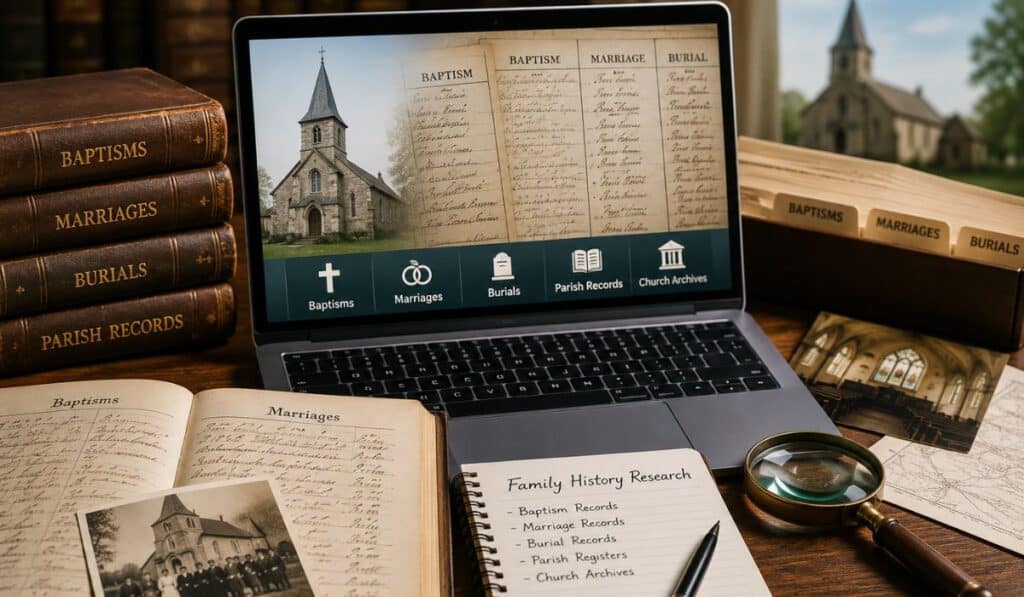
Church records are some of the most valuable resources for genealogy and family history research. Long before government birth certificates, civil marriage licenses, and official death records became common, churches documented important life events for local communities.
For many researchers in the United States, church archives can help fill gaps that census records, courthouse files, and newspaper archives cannot. Baptism registers may reveal a child’s parents. Marriage records can identify maiden names. Burial entries often provide dates and family connections missing from cemetery databases.
Today, millions of these records are available through church records online databases, genealogy platforms, historical archives, and digitized parish collections. Some websites offer free church records search tools, while others require subscriptions for full access.
This guide explains:
- What church records are
- Which types of records are available online
- The best websites to search church records online
- Free and paid genealogy resources
- How to search effectively
- Common research problems
- Access restrictions and privacy limitations
Whether you are researching colonial ancestors, immigrant families, or local parish histories, these resources can significantly improve your family history research.
What Are Church Records?
Church records are documents created and maintained by religious institutions. These records often predate government recordkeeping systems, especially in the United States and Europe.
Churches historically recorded:
- Baptisms
- Christenings
- Marriages
- Burials
- Confirmations
- Membership rolls
- Parish censuses
- Communion records
- Funeral services
- Conversion records
In many areas, church registers acted as unofficial civil records before state governments established formal vital records systems.
For genealogy researchers, family history church records are especially important for:
- Identifying parents and children
- Tracing maiden names
- Confirming birth or death dates
- Finding immigrant origins
- Understanding religious affiliations
- Connecting generations before the 1800s
Church records can also reveal social and community history. Witnesses, sponsors, godparents, and clergy names often help identify relatives and close family associates.
Types of Church Records Available Online
Different churches maintained different kinds of records. Availability varies depending on denomination, region, and historical preservation efforts.
Baptism Records
A baptism records search is one of the most common genealogy tasks.
Baptism records may include:
- Child’s full name
- Birth date
- Baptism date
- Parents’ names
- Godparents or sponsors
- Parish location
- Clergy member
These records are especially useful when civil birth certificates do not exist.
Marriage Records
Church marriage records often contain:
- Bride and groom names
- Parents’ names
- Marriage date
- Witnesses
- Residence information
- Parish details
Catholic and Lutheran marriage registers are particularly detailed in some regions.
Burial Records
Burial records online may include:
- Date of burial
- Date of death
- Age
- Cause of death
- Cemetery information
- Family relationships
Some parish burial records exist even when no gravestone survives.
Confirmation Records
Confirmation records can help identify teenagers or young adults in church communities.
These records sometimes include:
- Parent names
- Birth information
- Residence
- Parish membership
Membership Lists
Some churches kept congregation membership books documenting:
- Family arrivals
- Transfers between churches
- Excommunications
- Deaths
- Community roles
Parish Histories and Registers
Historical church archives may also contain:
- Parish histories
- Church newsletters
- Photographs
- Maps
- Anniversary publications
- Local community records
Best Websites To Search Church Records Online
The following websites are among the best resources for genealogy church records and historical religious archives.
Comparison Table: Best Church Record Websites
| Website | Free/Paid | Record Types | Best For | USA Coverage | International Coverage |
|---|---|---|---|---|---|
| FamilySearch | Free | Baptism, marriage, burial, parish records | Beginners and broad genealogy | Excellent | Excellent |
| Ancestry | Paid | Church, census, immigration, family trees | Large record collections | Excellent | Strong |
| Findmypast | Paid | Parish and British church records | UK and Irish ancestry | Moderate | Excellent for UK |
| MyHeritage | Paid | Global genealogy records | International family research | Good | Strong |
| Archives.com | Paid | Vital and church records | Simple searching | Good | Limited |
| AmericanAncestors | Paid | New England church records | Colonial research | Excellent for Northeast | Limited |
| AccessGenealogy | Free | Transcriptions and local records | Free historical research | Moderate | Limited |
| USGenWeb | Free | County-level genealogy data | Local community research | Excellent | Minimal |
| Internet Archive | Free | Digitized church books and histories | Historical publications | Moderate | Moderate |
| National Archives | Free | Federal historical records | Supporting documentation | Good | Limited |
#1 FamilySearch
FamilySearch is one of the most important genealogy resources available online.
Created by The Church of Jesus Christ of Latter-day Saints, it provides millions of digitized church records at no cost.
What Records It Contains
- Baptism registers
- Marriage records
- Burial records
- Parish registers
- Catholic church records
- Lutheran records
- Methodist archives
- Quaker records
Free or Paid?
Completely free with account registration.
Best Use Cases
- Beginners starting genealogy research
- USA family history
- European parish records
- Immigration-era ancestry
Search Strengths
- Massive collection size
- Free access
- Indexed and digitized images
- Strong international coverage
Weaknesses
- Some images restricted to viewing at partner libraries
- Search filters can feel overwhelming for beginners
Geographic Coverage
Excellent coverage for:
- United States
- Mexico
- Canada
- Germany
- Italy
- Ireland
- Scandinavia
- Latin America
Beginner Friendliness
Very beginner-friendly once users learn filtering tools.
#2 Ancestry
Ancestry is one of the largest subscription genealogy platforms.
What Records It Contains
- Church baptism records
- Marriage records
- Cemetery indexes
- Parish collections
- Historical newspapers
- Census records
Free or Paid?
Primarily paid, though some collections are free during promotions.
Best Use Cases
- Building family trees
- Combining church and civil records
- DNA-linked genealogy research
Search Strengths
- Strong search engine
- Hints and matching tools
- Extensive US collections
Weaknesses
- Subscription cost
- Some collections require higher-tier plans
Geographic Coverage
Very strong for:
- United States
- Canada
- United Kingdom
- Germany
Beginner Friendliness
Excellent for beginners because of guided tree-building features.
#3 Findmypast
Findmypast specializes in British and Irish genealogy.
What Records It Contains
- Parish registers genealogy collections
- Anglican church records
- Catholic records
- Burial registers
- Monumental inscriptions
Free or Paid?
Paid subscription with limited free searching.
Best Use Cases
- English ancestry
- Irish parish research
- British Isles church history
Search Strengths
- Excellent parish collections
- Strong newspaper archive integration
Weaknesses
- Limited US church collections
- Less useful for non-UK ancestry
Geographic Coverage
Best for:
- England
- Ireland
- Scotland
- Wales
Beginner Friendliness
Moderately easy to use.
#4 MyHeritage
MyHeritage focuses heavily on international genealogy.
What Records It Contains
- Church books
- Family trees
- Baptism and marriage records
- Cemetery indexes
- Historical documents
Free or Paid?
Freemium model with paid subscriptions for advanced access.
Best Use Cases
- International family research
- Immigrant ancestry
- European church archives
Search Strengths
- Multilingual support
- International databases
- AI-assisted record matching
Weaknesses
- Some duplicate records
- Subscription required for many collections
Geographic Coverage
Strong for Europe and Latin America.
Beginner Friendliness
Good interface for new researchers.
#5 Archives.com
Archives.com offers a simpler genealogy experience.
What Records It Contains
- Marriage records
- Burial indexes
- Church collections
- Census records
Free or Paid?
Paid subscription.
Best Use Cases
- Basic genealogy searches
- Fast name lookups
Search Strengths
- Simple interface
- Easy navigation
Weaknesses
- Smaller collection size
- Limited international coverage
Geographic Coverage
Mostly United States.
Beginner Friendliness
Very easy for beginners.
#6 AmericanAncestors
AmericanAncestors is operated by the New England Historic Genealogical Society.
What Records It Contains
- Colonial church records
- Congregational records
- New England parish records
- Early American genealogy collections
Free or Paid?
Mostly paid with some free databases.
Best Use Cases
- Colonial ancestry
- Early New England research
Search Strengths
- High-quality curated databases
- Strong scholarly accuracy
Weaknesses
- Narrower geographic focus
Geographic Coverage
Excellent for Northeastern United States.
Beginner Friendliness
Better suited for intermediate researchers.
#7 AccessGenealogy
AccessGenealogy provides free genealogy materials.
What Records It Contains
- Transcribed church records
- Cemetery listings
- Historical books
- Native American genealogy resources
Free or Paid?
Free.
Best Use Cases
- Budget genealogy research
- Supplementary local records
Search Strengths
- Free access
- Historical transcriptions
Weaknesses
- Limited digitized images
- Uneven coverage
Geographic Coverage
Mostly US-focused.
Beginner Friendliness
Easy to browse.
#8 USGenWeb
USGenWeb is a volunteer-driven genealogy project.
What Records It Contains
- County-level church transcriptions
- Cemetery records
- Marriage indexes
- Local archives
Free or Paid?
Completely free.
Best Use Cases
- County-level research
- Rural ancestry
- Small community records
Search Strengths
- Local expertise
- Rare volunteer transcriptions
Weaknesses
- Inconsistent formatting
- Some counties sparsely documented
Geographic Coverage
Excellent US county coverage.
Beginner Friendliness
Moderate.
#9 Internet Archive
Internet Archive contains digitized books and church histories.
What Records It Contains
- Parish histories
- Church anniversary books
- Historical directories
- Religious publications
Free or Paid?
Free.
Best Use Cases
- Historical context
- Church history research
- Reading old parish books
Search Strengths
- Massive digital library
- Downloadable books
Weaknesses
- Limited indexing
- Requires manual searching
Geographic Coverage
Global.
Beginner Friendliness
Moderate learning curve.
#10 National Archives
National Archives does not specialize in church records directly, but it supports genealogy research through federal historical records.
What Records It Contains
- Military records
- Immigration documents
- Naturalization files
- Historical census records
Free or Paid?
Mostly free.
Best Use Cases
- Supporting church record research
- Immigration verification
Search Strengths
- Official federal archives
- Historical accuracy
Weaknesses
- Limited direct parish records
Geographic Coverage
United States.
Beginner Friendliness
Moderately beginner-friendly.
Church-Specific Archive Websites
Many denominations maintain their own archives.
Examples include:
- Catholic diocesan archives
- Lutheran synod archives
- Episcopal archives
- Methodist historical societies
- Presbyterian archives
These can contain records unavailable elsewhere.
Common Features
- Parish sacramental records
- Diocesan directories
- Historical registers
- Church histories
Limitations
- Many are not fully digitized
- Access rules vary
- Some require written requests
Free Church Records Websites
Many researchers begin with free church records search resources before paying for subscriptions.
Best Free Options
FamilySearch
Best overall free genealogy database.
USGenWeb
Excellent for county research.
AccessGenealogy
Useful for transcriptions and historical material.
Internet Archive
Strong for historical church publications.
National Archives
Helpful for supporting records.
Paid Church Record Databases
Paid websites generally provide:
- Better indexing
- Larger collections
- Faster searching
- Advanced filtering
- Integrated family tree tools
Best Paid Platforms
Ancestry
Best overall paid genealogy database.
Findmypast
Best for British Isles church records.
MyHeritage
Strong international coverage.
AmericanAncestors
Excellent for colonial New England research.
Best Websites for Catholic Church Records
Catholic church records are among the most detailed historical parish records available.
FamilySearch
Strong collections from:
- Italy
- Mexico
- Poland
- Ireland
- Latin America
Findmypast
Excellent for Irish Catholic parish records.
MyHeritage
Useful for European Catholic ancestry.
Diocesan Archives
Many dioceses maintain independent archives.
Examples include:
- Archdiocese archives
- Parish sacramental registries
- Seminary archives
Some Catholic records date back to the 1500s.
How To Search Church Records Effectively
Finding records requires more than typing a name into a search box.
Start With Known Facts
Begin with:
- Full names
- Approximate dates
- Locations
- Religious denomination
Even small details matter.
Search Nearby Areas
Families often attended churches outside their hometowns.
Try:
- Neighboring counties
- Nearby parishes
- Regional dioceses
Use Alternate Spellings
Older church records frequently contain spelling variations.
Examples:
- Johnson / Jonson
- Catherine / Katherine
- Schmidt / Smith
Search by Parents or Witnesses
If a direct search fails:
- Search parent names
- Search marriage witnesses
- Search godparents
These people were often relatives.
Browse Images Manually
Indexed searches do not include every record.
Sometimes the only way to find a record is by browsing digitized parish books page by page.
Tips for Finding Difficult Records
Some records are difficult because of missing indexes, damaged books, or historical migration patterns.
Understand Religious History
Different ethnic groups attended different churches.
Examples:
- German immigrants often attended Lutheran churches
- Irish immigrants commonly attended Catholic parishes
- Scandinavian immigrants used state churches
Learn Historical Boundaries
County and parish borders changed over time.
A family may appear in records from multiple jurisdictions.
Search Latin Names
Older Catholic church records may use Latin versions of names.
Examples:
| English | Latin |
|---|---|
| John | Johannes |
| Mary | Maria |
| Joseph | Josephus |
| James | Jacobus |
Read Handwriting Carefully
Old parish registers often use:
- Gothic handwriting
- Script abbreviations
- Latin phrases
Compare letters across entries to decode difficult words.
Look for Sponsors and Witnesses
Godparents and witnesses were frequently relatives.
These names can confirm family connections.
Common Problems When Searching Church Archives
Genealogy researchers frequently encounter obstacles.
Missing Records
Some church books were destroyed by:
- Fires
- Floods
- Wars
- Poor storage conditions
Incomplete Digitization
Not every parish archive is online.
Some collections remain available only through:
- Local churches
- Historical societies
- Microfilm
- Physical archives
Restricted Access
Some churches limit access to recent records.
This is especially common for:
- Baptisms
- Marriage records
- Confirmation records
Language Barriers
Older records may appear in:
- Latin
- German
- Polish
- French
- Spanish
Translation tools can help, but historical terminology still requires careful interpretation.
Index Errors
Transcription mistakes are common.
A surname may be indexed incorrectly because of:
- Difficult handwriting
- Damaged pages
- Unfamiliar spellings
Privacy Rules and Access Restrictions
Many church archives restrict recent records for privacy reasons.
Common Restrictions
Access limitations may apply to:
- Birth and baptism records
- Marriage records
- Adoption information
- Recent burial entries
Why Restrictions Exist
Churches protect:
- Personal privacy
- Identity information
- Religious confidentiality
Some records are also protected by state or national laws.
Typical Access Windows
Many archives restrict access for:
- 70–100 years for baptisms
- 50–75 years for marriages
- 25–50 years for burials
Rules vary widely.
How To Request Restricted Records
Researchers may need to provide:
- Proof of relationship
- Identification
- Written requests
- Fees for document copies
Beginner Guidance for Reading Old Church Records
Historical church records can be difficult to interpret at first.
Common Abbreviations
Church clerks often abbreviated words.
Examples:
| Abbreviation | Meaning |
|---|---|
| b. | born |
| bap. | baptized |
| d. | died |
| bur. | buried |
| w/o | wife of |
Calendar Differences
Some older records used different calendars.
Dates before the 1700s can occasionally appear inconsistent.
Handwriting Styles
Practice reading:
- Cursive script
- Gothic handwriting
- Latin parish entries
Studying multiple pages improves recognition.
Use Context Clues
Compare nearby entries for:
- Repeated surnames
- Similar place names
- Clergy handwriting patterns
How Church Records Help Family History Research
Church archives provide more than names and dates.
They can reveal:
- Migration patterns
- Religious identity
- Ethnic background
- Community relationships
- Family connections
For example:
- Baptism sponsors may identify grandparents
- Marriage witnesses may reveal siblings
- Burial locations may connect generations
Church records are especially valuable when researching periods before statewide vital records systems existed.
Conclusion
Church records remain one of the most important sources for genealogy and family history research. They help researchers trace ancestors before government vital records became common and often contain details unavailable elsewhere.
The best websites to search church records online depend on your research goals.
For free access, FamilySearch is usually the strongest starting point. For broader subscription databases, Ancestry and MyHeritage provide extensive collections and search tools. Researchers focused on British ancestry often benefit most from Findmypast, while local US genealogy research frequently improves with resources like USGenWeb and AccessGenealogy.
Successful church record research requires patience, flexible searching, and attention to historical context. Names changed, borders shifted, and records were kept differently across regions and denominations. Even so, church archives continue to help millions of people reconnect with family history, ancestral communities, and historical roots.
FAQs (Frequently Asked Questions)
1. What is the best website to search church records online?
FamilySearch is widely considered the best free resource because it offers millions of digitized church records from the United States and other countries. Paid platforms like Ancestry and Findmypast provide additional collections and advanced search tools.
2. Are church records free online?
Some church records online are free through websites like FamilySearch, USGenWeb, and Internet Archive. Other databases require subscriptions.
3. Can I search Catholic church records online?
Yes. Many Catholic church records are available through FamilySearch, diocesan archives, and genealogy platforms like Findmypast and MyHeritage.
4. What information is found in baptism records?
Baptism records often include:
- Child’s name
- Birth date
- Baptism date
- Parents’ names
- Godparents
- Parish name
5. Why can’t I find certain church records online?
Some records may be:
- Undigitized
- Lost or damaged
- Restricted for privacy reasons
- Indexed incorrectly
Researchers sometimes need to contact local churches or archives directly.
6. Are church marriage records accurate?
Church marriage records are usually reliable because clergy recorded them close to the event date. However, spelling variations and transcription errors can still occur.
7. How old are the oldest church records?
Some European parish records date back to the 1500s. In the United States, surviving church records commonly begin in the 1600s or 1700s depending on the region.

I am Sandy Saga, the writer and content researcher behind FamilyTreeNow.net. I create clear, easy-to-understand informational content related to family history, people search resources, genealogy topics, and public information awareness. My goal is to help readers understand how online search tools and family research resources work in a simple and responsible way.
The content on FamilyTreeNow.net is published strictly for informational and educational purposes only. I focus on providing accurate, transparent, and reader-friendly information to help users explore and learn. This website does not offer official records, legal advice, or professional services — it exists solely as an independent informational resource.