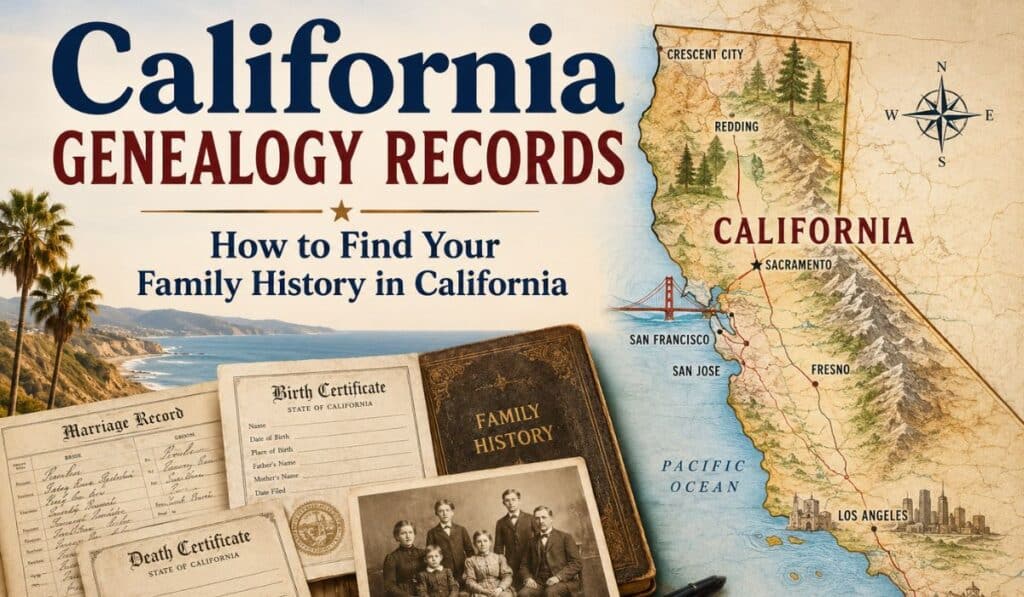
California has long been one of America’s most fascinating destinations for genealogy research. Few states experienced such dramatic waves of migration, cultural change, economic opportunity, and population growth over a relatively short period of time. From Native communities and Spanish missions to Gold Rush settlers, railroad workers, agricultural families, and modern immigration, California genealogy records reveal stories from nearly every corner of the world.
For anyone building a family tree, California presents both incredible opportunities and unique challenges. The state’s size, diverse population, and historical events created an enormous collection of historical records—but they are spread across counties, archives, churches, libraries, and digital collections.
Whether your ancestors arrived during the Spanish colonial period, came west searching for gold, helped build railroads, worked farmland, or settled after World War II, California genealogy records can help reconstruct generations of family history.
Why California Is Unique for Genealogy Research
California is unlike many eastern states where families remained in the same counties for centuries. Instead, California became a destination state.
Its geography played a major role.
The Pacific coastline opened maritime trade routes. Fertile valleys supported agriculture. Mountain regions attracted mining and lumber industries. Ports connected California with Asia and Latin America.
This constant movement of people created an unusually diverse historical record.
Researchers often discover ancestors who appeared in California after living in multiple states—or even several countries.
California genealogy frequently involves tracing movement patterns rather than researching one location alone.
Early California History and Settlement
Before European arrival, California was home to hundreds of Native communities living across mountains, valleys, deserts, and coastal regions.
Spanish Exploration and Mission Era (1542–1821)
European history in California began when Spanish explorers traveled along the Pacific coast during the sixteenth century.
Permanent settlement developed much later.
Beginning in the late eighteenth century, Spanish authorities established missions and military settlements in southern California and gradually expanded northward.
These missions became some of California’s earliest organized record systems.
Mission records may include:
- Baptisms
- Marriages
- Death registers
- Family relationships
- Indigenous conversions
- Settlement information
These documents remain valuable for genealogy researchers studying California before statehood.
Mexican California and Early Migration (1821–1848)
After Mexican independence from Spain, California entered a new phase of development.
Land grants expanded.
Ranching communities grew.
Trade increased along the Pacific coast.
This period introduced additional population movement into the region.
Researchers exploring ancestors from this era should investigate:
- Mexican land grant records
- Church archives
- Civil administration records
- Property transfers
- Migration documentation
Many early family histories in California begin during this period.
The Gold Rush and Population Explosion
No event transformed California genealogy more than the Gold Rush.
Gold discoveries accelerated migration at an extraordinary scale.
People traveled from:
- Eastern United States
- Mexico
- Europe
- South America
- China
- Canada
- Pacific regions
Entire communities appeared almost overnight.
Between 1850 and 1900, California experienced rapid population growth as mining expanded and supporting industries developed.
Genealogy researchers frequently find ancestors listed as:
- Miner
- Merchant
- Carpenter
- Teamster
- Hotel owner
- Farmer
- Transport worker
Gold Rush-era records can include:
Mining Records
Claims, ownership records, and local registries.
Census Records
Federal census records provide household information.
Land Ownership Files
Useful for tracking family movement.
Local Newspapers
Announcements, legal notices, and business activity.
California Statehood and Expansion
California officially became a U.S. state in 1850.
Statehood brought more structured record keeping.
Government agencies began documenting:
- Births
- Marriages
- Deaths
- Property ownership
- Court activity
This period is especially valuable because official records become easier to locate.
Researchers should note that statewide registration became more standardized later, so county-level searches are often necessary for nineteenth-century records.
Immigration and Cultural Diversity in California
California genealogy stands out because migration never stopped.
Throughout the nineteenth century, people continued arriving from different backgrounds.
Chinese Immigration and Railroad Development
Large numbers of laborers arrived from China and played major roles in railroad construction and infrastructure growth.
Records to investigate include:
- Immigration manifests
- Employment documents
- Community association archives
- Naturalization files
Agricultural Settlement
Immigrant communities helped develop California agriculture.
Family records may appear in:
- Farm ownership records
- Labor records
- County directories
Religious Communities
Religious migration also shaped California.
Church membership records often preserve:
- Family structures
- Marriage records
- Burial information
The Railroad Era and Internal Migration
Completion of major rail connections transformed California.
Travel became easier.
Families relocated permanently from across America.
Genealogy searches often reveal movement from:
- Midwest farming states
- Southern states
- Northeastern cities
Useful records from this era include:
- Passenger records
- County directories
- Property ownership
- Occupational listings
Tracing migration routes can explain sudden appearances in California census documents.
Natural Disasters and Lost Records
California researchers should understand one major obstacle.
Historical disasters damaged important records.
San Francisco Earthquake and Fire (1906)
The destruction affected:
- Local government documents
- Church archives
- Business files
- Personal collections
When records disappear, researchers should expand searches into:
- Newspapers
- Tax rolls
- Insurance records
- Neighboring counties
- Probate files
Alternative sources often fill historical gaps.
California During the Twentieth Century
The twentieth century brought another wave of population growth.
Economic opportunities attracted millions.
Industries expanded into:
- Agriculture
- Manufacturing
- Shipping
- Entertainment
- Technology
Migration accelerated during:
The Great Depression
Economic hardship pushed families west.
World War II
Defense industries attracted workers.
Postwar Expansion
Suburban growth reshaped California communities.
Researchers may locate ancestors using:
- Military records
- Employment directories
- Voter registrations
- School yearbooks
- City directories
Types of California Genealogy Records
Birth Records
Birth records often include:
- Full name
- Parents’ names
- Birthplace
- Residence
- Occupation
These documents provide foundational family connections.
Marriage Records
Marriage records may reveal:
- Maiden names
- Witnesses
- Previous marriages
- Residence information
Death Records
Death certificates frequently contain:
- Cause of death
- Parents’ names
- Burial location
- Informant details
Census Records
Census records remain among the most valuable genealogy tools.
Typical information includes:
- Household members
- Ages
- Occupations
- Birthplaces
- Property ownership
Land Records
Land ownership records can reveal:
- Economic status
- Migration timing
- Family relationships
Probate Records
Probate documents may include:
- Wills
- Estate inventories
- Heir information
Newspaper Archives
Historical newspapers help researchers uncover:
- Obituaries
- Marriage announcements
- Community involvement
Cemetery Records
Burial records often connect generations and identify relatives not found elsewhere.
Step-by-Step California Genealogy Search Strategy
Step 1: Start With Known Relatives
Collect:
- Names
- Dates
- Locations
- Family stories
Step 2: Build a Timeline
Track movement across decades.
Step 3: Gather Official Documents
Prioritize:
- Birth
- Marriage
- Death
- Census
Step 4: Compare Multiple Sources
Never rely on one record alone.
Step 5: Expand to Historical Collections
Use archives and specialized repositories.
Common Challenges in California Genealogy
Frequent Relocation
Families moved repeatedly.
Name Variations
Spellings changed over time.
Missing Records
Use substitute sources.
Cultural Differences
Naming traditions vary across communities.
Tips for Better California Family Research
- Search county records first.
- Record every source.
- Create migration maps.
- Save document images.
- Build timelines.
- Recheck older assumptions.
Genealogy is rarely solved in one search.
Final Thoughts
California genealogy records tell stories far beyond names and dates. They reveal journeys across oceans, movement across states, economic opportunity, and generations adapting to one of America’s most dynamic regions.
Whether your ancestors arrived during Spanish settlement, chased opportunity during the Gold Rush, helped build railroads, worked agricultural lands, or moved west in the twentieth century, California records provide opportunities to reconnect with family history.
Start with one document, follow each clue carefully, and allow every record to guide the next step. Family history research in California is not simply about discovering ancestors—it is about understanding the paths that brought families together across generations.

I am Sandy Saga, the writer and content researcher behind FamilyTreeNow.net. I create clear, easy-to-understand informational content related to family history, people search resources, genealogy topics, and public information awareness. My goal is to help readers understand how online search tools and family research resources work in a simple and responsible way.
The content on FamilyTreeNow.net is published strictly for informational and educational purposes only. I focus on providing accurate, transparent, and reader-friendly information to help users explore and learn. This website does not offer official records, legal advice, or professional services — it exists solely as an independent informational resource.