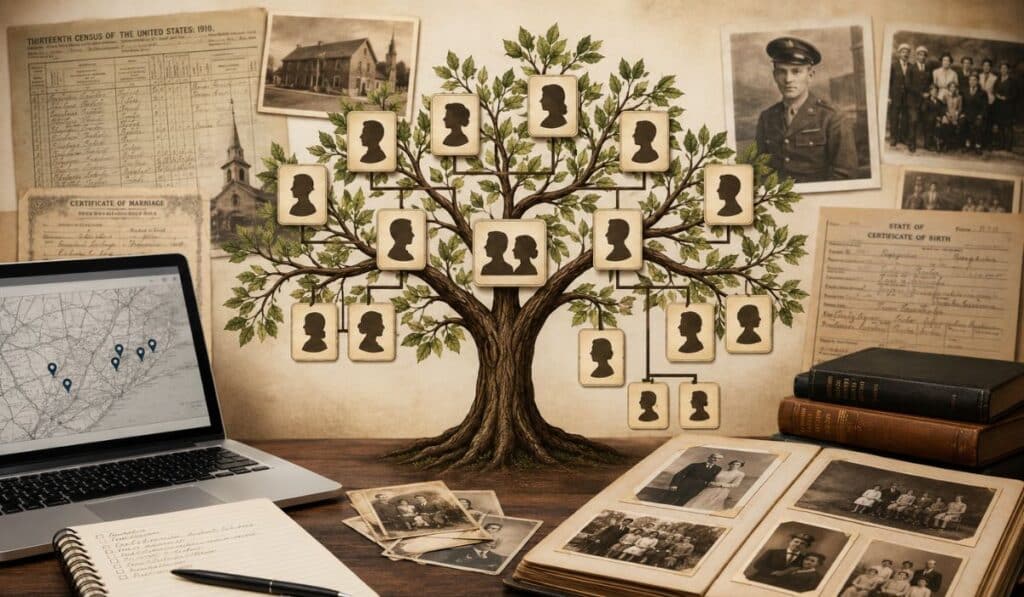
Knowing where you come from is powerful, and understanding that history is a valid avenue of power. The family tree is an illustration of your own personal journey, and the people, events, and relationships that created who you are today. Genealogy is too often seen as complicated or expensive, or that it should only be done by professionals. The truth is you can create a family tree with basic records and the right amount of time and effort.
This guide is an ideal place for beginners to get started with research. You will understand the steps you need to take in advance of doing research, how to properly use birth, marriage, and census records, how you should avoid certain common mistakes, and how free and paid genealogy tools compare. When you complete the guide, you’ll have the knowledge and skills to start researching your genealogy.
Why building a family tree matters
A variety of reasons motivate individuals to begin researching their family trees. Some want to pass down stories to future generations, while others simply want to learn more about their ancestry, cultural background and migration history. Some individuals seek out relatives they have lost contact with, while others want to gain a fuller understanding of who they are as individuals.
Genealogy is not only about the facts – it also provides insights into patterns . You might find occupations that have been carried down over many generations, migration patterns that repeat themselves and certain strong family values that have helped families survive tough times. If you are new to genealogy, your quest usually begins with a question that is as basic as “Who were my ancestors?”
Start with what you already know
Before embarking on an online search or accessing a database, take a moment to stop and think about what you already know. You’re likely to have at least some information about your family – though this step may be skipped by people searching for their family tree, it’s very important in this type of research.
Start by writing down some general information about yourself
Start with yourself and go backwards – then write down:
Your complete name (full name, all middle names)
Your date of birth and where you were born
Your parents and grandparents’ names (ideally with dates)
Approximate year of birth for each of them
All known marriages or divorces
All siblings or children that you know of (with dates if possible)
Don’t worry about being precise; even if some of these details are not correct or missing, they still help!
Family Records will provide valuable insight into your genealogy. After your living relatives, nothing is more useful than speaking with them, asking open-ended questions like:
What was the origin of our family?
What were the names of your grandparents?
What family stories do you know about our ancestors?
You should record these conversations or note down details, as sometimes it might just be a small detail that will give you information about the place your ancestors came from, or what they did for a living.
Family Records will also help identify your ancestors through physical or digital records including:
Birth and Marriage certificates
Old Passports
School Records
Diaries / Letters
Funeral cards / Obituaries
Photo Albums
Even if they are burnt, damaged, or incomplete, you will still find the names and dates, which you can cross-check against public records to learn more about your ancestors.
Understand what public records are
Government agencies create and keep public records. Many of these records are legally available to the public, and they are a vital source of information for genealogical research. When researching genealogy, newcomers will find that understanding the main types of public records will prevent confusion and lost time. The most commonly researched public records in genealogy are:
Birth Records
A birth record usually contains the child’s name, date of birth, location of birth, and parent names. The rate of access to these records varies by country and state, with many older records being available.
Marriage Records
A marriage certificate usually contains the names, ages, and places of birth of the couple, as well as their parents’ names (when known). The importance of marriage records for linking generations is undisputed.
Death Records
A death certificate typically contains the date and location of death, as well as the person’s age, profession, marital status, and next of kin.
Census Records
Census records document the population of a country at a point in time and may include a household’s name(s), age(s), relationship(s), occupation(s), and place(s) of birth.
Voter, property, and court records
These records can help trace the physical movement of an individual, the historical residency of an individual or family, and relationships between family members over time.
Although public records contain facts, they are not always free from errors. Therefore, it is crucial to evaluate and verify records from multiple sources.
Use birth records to anchor your family tree
When genealogists begin searching for their ancestors, they typically begin with the use of birth records. The birth record is often viewed as an anchor point since it provides evidence of who you are and who your parents are.
To ensure an effective search of birth records, Flexible options should be considered in developing your search criteria included:
1) Use both the full name and shortened versions of the person you are researching to try to locate records.
2) If you can’t locate the exact date of birth, use an approximate date or time period to begin your search.
3) Begin your search by conducting a search by location first and then expand your search to potentially encompass a larger geographical area.
4) If there is no record located immediately, don’t assume that there is no record for that individual. Certain records may be indexed under a different last name, misspelled or recorded at a later date than the actual event.
5) Extracting essential information from birth records is not only vital to your research but will also assist you with obtaining future records through the use of the information you obtained from the initial record. Essential information includes:
– Full names of both parents
– Mother’s maiden name
– Place of residence at time of birth
Use marriage records to connect generations
Often, family relationships revealed by marriage records cannot be identified with just the information on birth certificates. Their most valuable use is that they can help identify female ancestors whose maiden names have been changed to married surnames.
Marriage documents provide helpful information such as:
Confirming family relationships,
Identifying an individual’s maiden name,
Linking two family trees,
Providing tips regarding where an individual’s family may have lived and/or what their economic status was at the time of the marriage,
For individuals who are beginning to research their family history, marriage records can help to answer why a family may experience a change in surname.
Tips for Utilizing Marriage Records:
When searching for a marriage record, you should search by both spouses’ names.
Be prepared to find records related to marriages that occurred multiple times (one or both spouses may have remarried).
Witnesses are often family members and can assist you with identifying family members indirectly or provide you with names of an individual who shares your surname.
Frequently, the names of witnesses are found in other records, allowing for the identification of additional family members.
Use census records to see families in context
Census Records Can Enhance Your Family History Research. It includes not only names and dates but also provides a picture of an entire family around the same time.
The Information Found in Census Records
Census records can include the following:
Names of all people living in a household
How they are related to each other
Their ages and where they were born
Occupation
Immigration status
Assessment of literacy or education level
Census records help provide an accurate timeline for your family history and can provide names for brothers and sisters you did not know existed.
Avoiding Common Census Errors
Census records have many errors; names may be spelled incorrectly or the wrong age may be listed. Enumerators often wrote as they heard names or provided what they thought were accurate ages or dates.
Things to Consider in Reducing Errors Are:
Examine several census years.
Accept Small Age differences.
Look at the overall pattern.
Build your tree slowly and verify everything
New genealogists make one of the most frequent mistakes when they attempt to move quickly when researching their family history. When a new researcher adds names without verifying them, there may be errors, which can complicate creating an accurate family tree for future generations.
Use two or more distinct sources to verify each relationship.
Record where you’ve located each item of information in your research.
Don’t assume that people can be identified as the same because they have the same name.
Genealogy is not a competition; your priority should be doing thorough and accurate research rather than completing the most quickly possible.
Common mistakes beginners make
Knowing what to do is only part of the process – you also need to know what not to do.
Using Unsourced Online Trees
Many new researchers copy other people’s family trees. Although these can be useful, they may have errors and should always be verified with other sources.
Ignoring Women’s Maiden Names
Maiden names are necessary for tracing maternal lineage. Without them, you may lose whole branches of your family.
Grouping People Who Have Similar Names
It is common to confuse people with similar names. Before merging records, you should always check dates, locations, and those related to the individuals.
Expecting Immediate Results
Family research takes time. It is common to hit dead ends; patience is necessary.
Free vs paid genealogy tools
Beginners typically ask themselves if they require paid tools to create a family tree. The decision is ultimately going to depend on what goals you want to achieve.
Digital genealogical tools without cost.
There are tools you can use without charge that are best for beginners. These tools will typically allow you to build a family tree using several different resources, such as:
A basic family tree builder tool.
Access to a limited number of public records.
Searchable access to names and/or locations.
These tools are more than adequate for helping you get started on a basic family tree and familiarizing yourself with the research techniques.
Paid genealogical tools.
Paid genealogy tools generally offer:
Much larger databases of individuals.
Advanced filtering options for searches.
Access to multiple databases of historical newspapers and records from around the globe.
Integrated DNA testing to assist with your research.
These tools are invaluable when you start to have complex research or cross borders to conduct your research.
How do I determine which one to utilize?
Utilize the free genealogical resources first. After you familiarize yourself with the methods you will be utilizing to research, you will be able to assess whether or not purchasing genealogy services is justifiable.
Organize your research properly
Staying organized not only saves time, but also helps you avoid mistakes.
Tips for Staying Organized:
Have a standard naming method
Have a digital copy of all records
Keep all research notes together
Keep a list of questions you need to find answers to
Think of your family tree as an ongoing project as opposed to a one-shot deal
Convert facts to narratives
Once you have names and dates you should dig deeper into the information; for example:
Why did this family relocate?
What was going on during this period of time?
How did these events impact their life?
Using historical context and emotional context makes your family tree more valuable than simply listing factual names and dates.
Frequently Asked Questions (FAQs)
Is it feasible to create a family tree without paying any fees?
Yes. There are a lot of freely available genealogy resources such as public records and family tree builders. Although paid versions of these tools contain more detail, you can still build a solid foundation using the free versions.
How far back can I go using public records?
The answer depends on your location as well as the availability of records in your area. Most people can trace their family back 3 to 5 generations using just free public records.
What happens if I find conflicting data?
It is not uncommon to find discrepancies in your data. Compare records from multiple sources, pay attention to the official records that you have found, and keep track of what you are uncertain about rather than guessing.
Do I have to be technically proficient to get started in genealogy?
No, as long as you have basic computer skills and patience you will be fine. Genealogy is more about how you reason through your findings and confirm them than it is about using computers or software.
How long will it take me to compile a complete family tree?
There is no guaranteed amount of time it will take you to create a complete family tree. Some people have been able to create a basic family tree in weeks while others have taken years to continue building upon their family tree.
A final reflective thought
Constructing a Family Tree is about more than just finding out who your ancestors were; it’s also about finding out the way resilience has traveled between them from generation to generation. Each of your records represents a person who lived, adapted, struggled, and thrived so that the next generation could come into existence. When you begin to look at the branches of your family tree to follow their journey, you will likely notice that many of these ancestors possessed a strength that subtly reflects who you are today. Like genealogy and family trees, growth takes time and effort, and is accomplished one step at a time by building on what has been provided by those who came before you and reaching for possibilities of the future.

I am Sandy Saga, the writer and content researcher behind FamilyTreeNow.net. I create clear, easy-to-understand informational content related to family history, people search resources, genealogy topics, and public information awareness. My goal is to help readers understand how online search tools and family research resources work in a simple and responsible way.
The content on FamilyTreeNow.net is published strictly for informational and educational purposes only. I focus on providing accurate, transparent, and reader-friendly information to help users explore and learn. This website does not offer official records, legal advice, or professional services — it exists solely as an independent informational resource.